"Can we talk to anybody about getting some outside imagery? We don't know much about the post-launch impact damage." — Rodney Rocha, NASA structural engineer, in an internal email sent 22 January 2003. The request was denied, twice more before the mission ended.
The piece of foam that killed seven astronauts was approximately the size of a small briefcase.
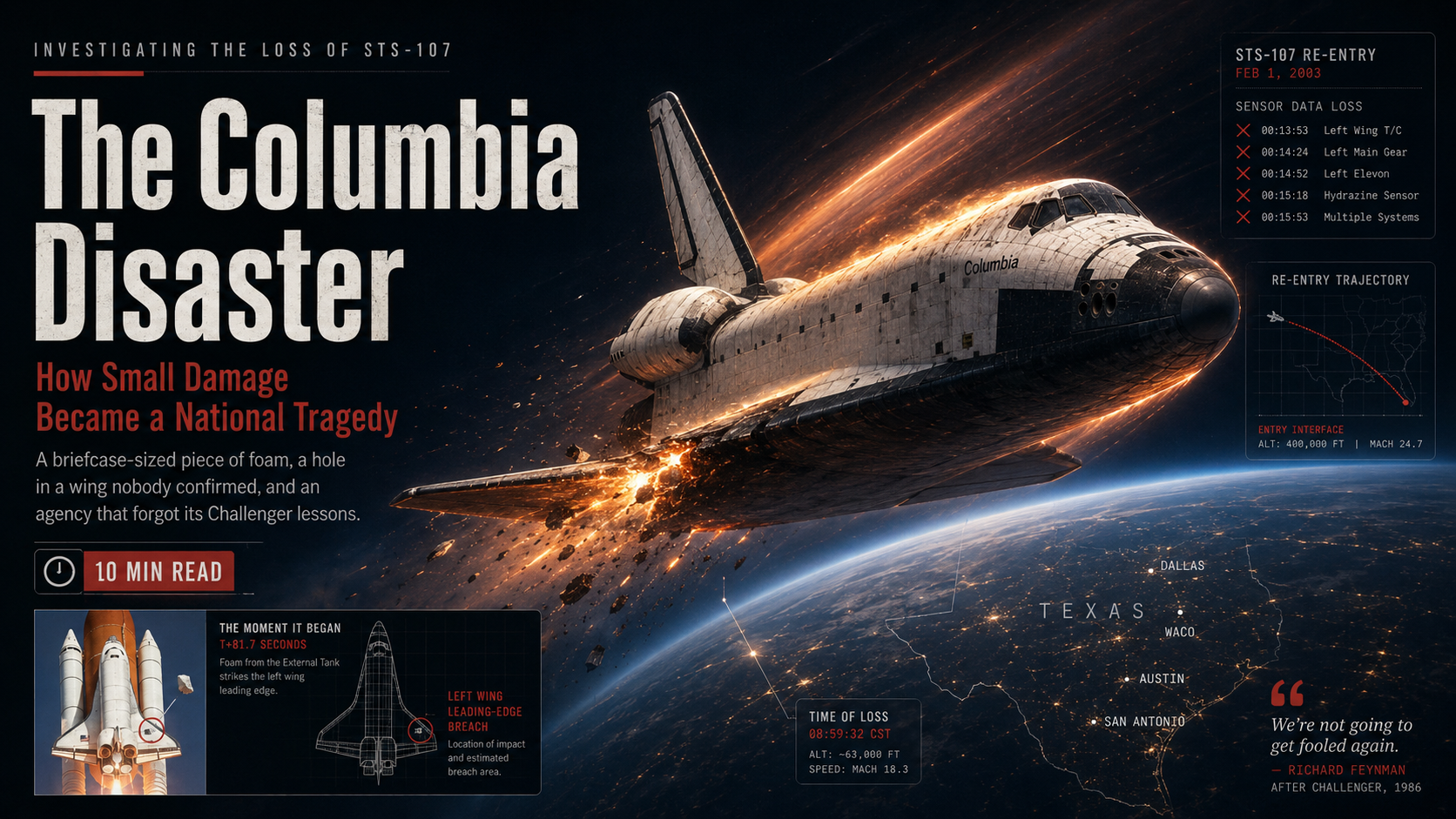
It weighed less than two pounds. It came loose from the External Tank of the Space Shuttle Columbia at 81.7 seconds into the launch on the morning of 16 January 2003, and it struck the leading edge of the orbiter's left wing at a relative speed of about 545 miles per hour . The collision lasted a fraction of a second. The launch cameras captured it. The white blur of the foam, the puff of debris as it shattered, the wing continuing into orbit as though nothing had happened.
Almost nothing had happened. Almost.
What the cameras did not show — what no one on the ground would confirm for the next sixteen days — was that the impact had punched a hole in the wing's protective thermal panels, somewhere between six and ten inches across. A hole large enough, when the spacecraft returned to Earth, for the superheated atmospheric plasma of re-entry to enter the wing's internal structure, melt the aluminium spar, and tear the orbiter apart at 200,000 feet over east Texas.
Seven people would die in the time it took to drive across an average American town.
What is harder to forgive — what the Columbia Accident Investigation Board would document, in clinical detail, over the seven months that followed — is that the engineers who most needed to know about the foam strike spent the mission begging for permission to find out, and were told, three separate times, that the matter was closed.
The Seven
The crew of STS-107 was, even by the standards of the shuttle programme, unusually international.
Crew Member Role Distinction
Rick Husband Commander Air Force test pilot, devout Christian, his second shuttle flight
William McCool Pilot Navy aviator, first spaceflight
Michael P. Anderson Payload Commander Astrophysicist, US Air Force lieutenant colonel
Kalpana Chawla Mission Specialist First Indian-born woman in space , born in Karnal, Haryana
David Brown Mission Specialist Navy flight surgeon and circus acrobat (genuinely)
Laurel Clark Mission Specialist Navy submarine medical officer
Ilan Ramon Payload Specialist First Israeli in space , son of Holocaust survivors
The mission itself was a science flight — a sixteen-day stay in low Earth orbit conducting microgravity experiments in biology, materials science, and Earth observation. Eighty separate experiments had been packed into the mid-deck and a Spacehab module in the cargo bay. Of the seven astronauts, six were performing science. The seventh, Ilan Ramon, carried a small Torah scroll that had survived Bergen-Belsen concentration camp , given to him by a fellow Israeli astronaut's family.
Kalpana Chawla had become, in the years before her flight, an inspiration to a generation of girls in India who suddenly believed that space might be open to them. She had flown once before. This was her second mission.
By the end of STS-107, every one of those seven private histories — the Torah scroll, the small-town childhoods in Haryana and Iowa and Tel Aviv, the test-pilot's certificates and the medical degrees — would be scattered across the pine forests and cattle pastures of east Texas and western Louisiana.
81.7 Seconds
The foam came from a section of the External Tank known as the bipod ramp — an aerodynamic fairing covering the structural fittings where the orbiter was attached to the tank. The ramp's foam insulation prevented ice from building up on the cold metal beneath.
Foam had broken off this region before. Many times before.
Mission Year Foam Loss Event
STS-7 1983 Significant foam loss from bipod ramp
STS-27 1988 Severe debris strike (tile damage; nearly catastrophic)
STS-32 1990 Bipod foam loss
STS-50 1992 Bipod foam loss
STS-52 1992 Bipod foam loss
STS-62 1994 Bipod foam loss
STS-87 1997 Significant foam loss
STS-112 October 2002 Bipod foam strike — three months before Columbia
The STS-112 strike, in particular, had been substantial. It had damaged the External Tank attach ring. After that flight, NASA managers had classified bipod foam shedding as a "turnaround issue" — a problem affecting how quickly the shuttle could be refurbished between missions — rather than a flight safety issue.
This decision is, in retrospect, the moment Columbia was lost. It was made in late 2002, by engineers and managers who reasoned that foam strikes had never caused fatal damage before , and therefore could be accepted as a recurring nuisance. The reasoning was identical, in form and in self-deception, to the O-ring tolerances NASA had accepted before Challenger.
The Columbia Accident Investigation Board would later coin a phrase for this pattern: the normalisation of deviance . It was borrowed from the sociologist Diane Vaughan, who had used it to describe the same psychological process at NASA in 1986.
The agency had read her book. The agency had assigned it as required reading. The agency had then proceeded to repeat the pattern.
The Engineers Who Asked
In the days after launch, the foam strike was reviewed at NASA's Mission Management Team. The video showed the impact. Engineers from the Debris Assessment Team — a working group convened specifically to evaluate such events — were tasked with analysing whether the strike had caused damage that might compromise re-entry.
They could not tell from the launch footage alone. The angle was wrong. The resolution was insufficient. They needed additional imagery — and the most realistic source was either the United States Department of Defense's classified spy satellites or telescopic ground-based imagery from US military assets.
A formal request was made. It was denied.
A second request was made. It was denied.
A third request was made. By this point, the engineers were sending unhappy internal emails to one another. Rodney Rocha, the lead structural engineer on the Debris Assessment Team, wrote on 22 January:
"In my humble technical opinion, this is the wrong (and bordering on irresponsible) answer from the [Shuttle Program] and Orbiter not to request additional imaging help from any outside source. I must emphasise (again) that severe enough damage... could present potentially grave hazards."
The MMT chair, Linda Ham , had concluded that the damage was a turnaround issue — meaning, even if it was confirmed, there was nothing to be done about it during the mission, and therefore confirming it served no purpose.
This conclusion was wrong in two respects. First, the engineers had not asked for the imagery in order to do nothing with it. They had asked because they did not yet know what they would do . Second, and more damningly, the CAIB would later determine that rescue or repair options did exist — they had simply not been seriously evaluated.
Option Feasibility (Per CAIB)
Emergency rescue by Atlantis (STS-114) Theoretically possible if launch preparation was accelerated; would have required Columbia to extend mission and conserve consumables
In-orbit EVA repair Possible with improvised materials; never tested
Re-entry profile modification Could reduce thermal load on damaged area; not investigated during mission
None of these options was pursued because the premise — that there might be damage worth worrying about — had been administratively dismissed.
By 27 January, the matter was closed at NASA management level. The crew had been informed, in a routine communication, that a "minor" foam strike had occurred at launch and that the team had reviewed it and found no concern. They were not told that engineers were still arguing about it. They were not given the option to perform an inspection EVA themselves.
The Re-entry
Columbia's de-orbit burn was performed at 8:15 AM Eastern Time on 1 February 2003, over the Indian Ocean. The shuttle began its descent toward Kennedy Space Center, scheduled to land at 9:16 AM.
The descent profile was nominal until 8:48 AM, when temperature sensors in the left wing began registering anomalous readings. They climbed slowly at first. Then they failed entirely. Mission Control noticed the sensor losses but, in the chaos of normal re-entry telemetry, did not yet understand their significance.
At 8:54 AM, debris began separating from the orbiter.
At 8:59 AM, Rick Husband made his last full transmission:
"Roger, uh, bu—"
Mission Control, on the ground, did not hear the transmission cut off. They had already lost data. They had not yet lost hope.
At 9:00:18 AM, witnesses across east Texas began telephoning local news stations, reporting multiple bright objects streaking across the morning sky, accompanied by sonic booms . By the time Mission Control understood what was happening — by the time it became clear that no contact could be re-established, that landing would not occur, that the shuttle was gone — pieces of Columbia were already falling onto barns, cattle ranches, schoolyards, and the porches of small Texas towns.
Crew remains were recovered. Personal effects were recovered. Notebooks, mission patches, a wedding ring. Ilan Ramon's diary, miraculously, was recovered partially legible. Pages of it are now displayed at Yad Vashem, the Holocaust memorial museum in Jerusalem.
The Torah scroll he had carried into space was destroyed.
The Columbia Accident Investigation Board
The investigation was led by retired Admiral Harold Gehman , who had previously investigated the bombing of the USS Cole . The CAIB worked for seven months. Its final report, published 26 August 2003, ran to nearly nine hundred pages.
The technical cause was unambiguous: foam from the bipod ramp had struck the leading edge Reinforced Carbon-Carbon (RCC) panels of the left wing, breaching the thermal protection system. During re-entry, superheated plasma at temperatures exceeding 2,500°F entered the wing's internal structure, melted the aluminium spar, and caused progressive structural failure.
But the CAIB's most-quoted finding was organisational , not technical:
"The organizational causes of this accident are rooted in the Space Shuttle Program's history and culture, including the original compromises that were required to gain approval for the Shuttle, subsequent years of resource constraints, fluctuating priorities, schedule pressures, mischaracterisation of the Shuttle as operational rather than developmental, and lack of an agreed national vision for human space flight."
Translated: NASA had spent two decades pretending the shuttle was a routine commercial vehicle when it had always been an experimental one, and the institutional culture had adapted to the pretence.
The board went further. It explicitly compared Columbia to Challenger:
"Both accidents were 'failures of foresight' in which history played a prominent role... In both cases, NASA management failed to learn from earlier opportunities to detect and address risk."
The Rogers Commission had warned, in 1986, against the normalisation of deviance . The CAIB found, in 2003, that NASA had quietly returned to it within a decade of being told not to.
What Ended, What Continued
The shuttle fleet was grounded for two and a half years . The International Space Station was kept operational entirely by Russian Soyuz spacecraft during this period — a quiet humiliation for the agency that had once held the Soviets at the bottom of a Cold War scoreboard.
When the shuttle returned to flight in July 2005 (STS-114), every launch thereafter was accompanied by mandatory orbital inspection procedures using a new Orbiter Boom Sensor System — a long extension arm with cameras and lasers, used to scan the underside of the orbiter for damage. Every mission except the final servicing flight to the Hubble Space Telescope had a second shuttle on standby for potential rescue.
Foam shedding from the bipod ramp was eliminated by redesign of the External Tank.
The shuttle programme itself was formally ended in 2011, eight years after Columbia. The decision had been made by President George W. Bush in 2004, in direct response to the CAIB report. The United States went on to spend the next nine years without independent crewed access to space, relying entirely on Russian rockets until SpaceX's Crew Dragon flew in 2020.
The seven crew members of STS-107 are commemorated on memorial plaques at the Kennedy Space Center, at Arlington National Cemetery, at the Israeli Air Force Museum in Hatzerim, and at Tagore Bal Niketan School in Karnal, India — Kalpana Chawla's childhood school. A small hill on Mars, photographed by the Spirit rover days after the disaster, was named the Columbia Hills in their memory. The seven summits of those hills bear the names of the seven astronauts.
The Lesson, Again
It is genuinely difficult to write about the Columbia disaster without writing about the Challenger disaster. The CAIB itself could not avoid the comparison. The two accidents are structurally identical, separated only by seventeen years and by a different physical failure mode.
Challenger (1986) Columbia (2003)
Crew lost 7 7
Technical cause O-ring seal failure in cold weather Foam strike damage to wing leading edge
Documented prior occurrences O-ring erosion on prior flights Foam shedding on prior flights
Engineer warnings prior to event Yes, written, ignored Yes, written, ignored
Management classification of risk "Acceptable" "Turnaround issue"
Underlying institutional cause Normalisation of deviance Normalisation of deviance
The phrase appears, in plain English, in the official reports for both accidents. The same phrase. The same diagnosis. Seventeen years apart.
We do not lose astronauts because spaceflight is impossibly difficult. Spaceflight is difficult, but humans have managed it for sixty-five years. We lose astronauts because, given enough time and enough institutional pressure, the same human tendency — to grow comfortable with risks that have not yet killed anyone — quietly returns. The Challenger taught us this. NASA wrote the lesson into its training manuals. And then, slowly, between 1986 and 2003, the agency stopped reading the manuals it had written.
Seven engineers had emailed each other in the days after launch. They had asked, in increasingly urgent language, whether anyone could please take a closer look at the wing. They had been told that the matter was closed. The shuttle came down at thirteen thousand miles per hour with a hole in it, and seven people died for the second time in NASA's history because the answer to a question — "are we sure?" — had been delivered before the question itself had been properly asked.
Related Notes / Sources Consulted
Columbia Accident Investigation Board (CAIB) Final Report , Volumes I–VI (August 2003) — primary investigative document; the most authoritative source on all aspects of the disaster.
Cabbage, Michael & Harwood, William. Comm Check… The Final Flight of Shuttle Columbia (Free Press, 2004) — definitive journalistic account by veteran space reporters.
Vaughan, Diane. The Challenger Launch Decision: Risky Technology, Culture, and Deviance at NASA (1996) — the foundational text on "normalisation of deviance"; explicitly cited by the CAIB.
Husband, Evelyn. High Calling: The Courageous Life and Faith of Space Shuttle Columbia Commander Rick Husband (Thomas Nelson, 2003) — first-hand family memoir.
NASA STS-107 Mission Archive — official mission records, including post-launch foam strike video.
Internal NASA email records — Rodney Rocha's Debris Assessment Team correspondence, declassified during the CAIB investigation.
Yad Vashem (Jerusalem) — Ilan Ramon memorial archive, including the recovered diary pages.
NASA Memorial Pages — STS-107 crew biographies and tribute records.
Editorial note: Every technical and personnel detail in this article is drawn from public investigative material, principally the CAIB report. Quoted statements and internal emails are reproduced from the published evidence record. The discussion of "normalisation of deviance" follows the analysis explicitly endorsed by the CAIB and rooted in Diane Vaughan's sociological work.