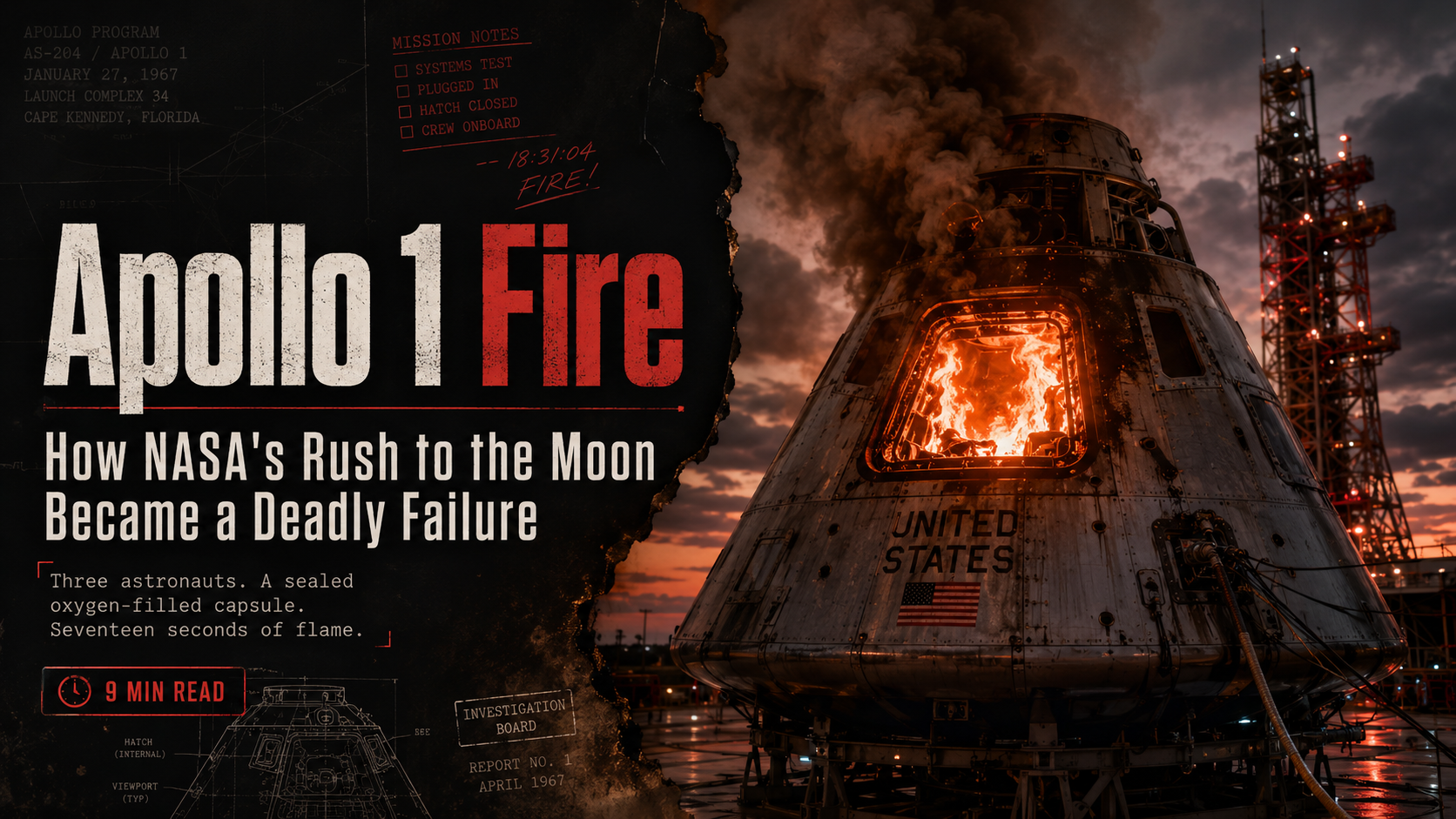
"How are we going to get to the Moon if we can't talk between two or three buildings?" — Virgil "Gus" Grissom, four minutes before the fire, after yet another communications failure during the Apollo 1 plugs-out test, 27 January 1967.
The three men strapped into the capsule that afternoon were, between them, almost every kind of American hero the 1960s had room for.
Gus Grissom , forty years old, had been the second American in space. He was a Mercury astronaut, a Gemini commander, a fighter pilot with a slow Indiana drawl and a famous distrust of NASA's engineers. He had nearly drowned in 1961 when the hatch of his Mercury capsule blew open on splashdown — and ever since, he had insisted that any future spacecraft he flew would have a hatch that could not open by accident. The engineers, dutifully, had given him one. It opened inward. It was sealed by atmospheric pressure. It took, by the manufacturer's own estimates, at least ninety seconds to operate from inside.
Ed White , thirty-six, was the first American to walk in space. The photograph of him tumbling weightless above the Pacific in 1965, gold visor reflecting the Earth, was already an icon. He was the son of a general, a West Point graduate, the kind of man who looked uncomplicated in the way only deeply complicated men can.
Roger Chaffee , thirty-one, had never been to space. Apollo 1 would have been his first flight. He was a Navy pilot, a father of two, said by his fellow astronauts to be the quickest study among the new selection. His voice would be the last clearly recorded from inside the capsule.
At 6:31 PM Eastern, on a cold Florida evening, all three of them died in less than half a minute.
The Test That Was Not Supposed to Be Dangerous
The exercise that night was called a "plugs-out" test — a full-up rehearsal of the launch sequence with the spacecraft sealed and running on its own power, but with no fuel in the rockets below.
It was considered routine. The mission itself, Apollo 1 (then officially designated AS-204 ), was scheduled to fly the following month. The plugs-out test was a checkout exercise, not a hazardous operation. Nobody, before that evening, had ever died in one.
Procedure Element Status
Spacecraft atmosphere 100% oxygen at 16.7 psi (above ambient pressure)
Fuel onboard None — boosters not loaded
Crew suited and sealed Yes
Hatch type Inward-opening, three-piece, manual
Estimated emergency egress time Approximately 90 seconds (best case)
Hazard classification Non-hazardous test
That last line is the one that matters. NASA's own safety regulations specified that emergency crews, asbestos suits, and fire suppression equipment were only required for hazardous tests. A plugs-out test was not classified as hazardous, because there was no propellant in the rocket below.
Nobody had updated the classification to reflect what was inside the capsule.
The Atmosphere That Was Already a Bomb
Pure oxygen, at sea-level pressure, is dangerous. Pure oxygen, at one and a half times sea-level pressure, is something else entirely.
In a normal atmosphere — 21% oxygen, 78% nitrogen — many materials are technically combustible but practically inert. Velcro will not burn at room temperature. Polymer wiring insulation chars but does not flame. A spark touches a frayed wire and produces, at most, a brief smell of singed plastic.
Place those same materials in a sealed, pressurised, 100% oxygen atmosphere , and the rules change completely:
Velcro burns like solid rocket propellant.
Aluminum, ordinarily considered noncombustible, will burn.
A spark in the wrong place becomes, in seconds, a flash fire.
NASA's spacecraft used pure oxygen at low pressure (about 5 psi) during flight, because it simplified the life-support system and saved weight. On the launch pad, however, the capsule had to be over-pressurised to prevent the hatch from leaking air inward from the higher external atmosphere. That meant 16.7 psi of pure oxygen — a fire hazard so extreme that no industrial chemist would have signed off on it, and yet so familiar to NASA's engineers that they had stopped seeing it as a hazard at all.
Inside the capsule that night, surrounded by Velcro patches, nylon netting, polyurethane foam padding, and several kilometres of insulated wiring, the crew was sitting in what amounted to a sealed chamber of oxidiser, waiting for an ignition source.
The ignition source, when it came, was almost certainly a frayed wire under Grissom's seat.
Seventeen Seconds
The plugs-out test had been going badly for hours. The communications between the capsule and the launch control centre were so unreliable that Grissom had been complaining over the open loop for most of the afternoon — his final transmission, captured on the recorders, was the line at the top of this article: How are we going to get to the Moon if we can't talk between two or three buildings?
At 6:30:55 PM, a brief voltage spike was logged in the spacecraft's electrical system.
At 6:31:04 PM, one of the crew — generally identified as Chaffee — said, calmly:
"Hey..."
A second later, the same voice said:
"Fire. We've got a fire in the cockpit."
There was a sound, perhaps White's voice, saying something the engineers later transcribed as "We've got a bad fire — let's get out — we're burning up."
The transmission ended in a sound that the official report describes only as a cry of pain.
The cabin pressure ruptured the hull within seventeen seconds of the first alarm. Pad technicians, watching through the access arm windows, saw a sheet of white fire pass behind the small glass viewports. They tried to reach the hatch. The capsule's exterior was now too hot to touch. By the time they forced the outer access cover open, perhaps five minutes later, the three men inside had been dead for at least four.
The official cause of death, in all three cases, was carbon monoxide asphyxiation . The thermal injuries — extensive and terrible — were post-mortem.
They did not suffer for long. The autopsy reports are clear on that. But for those few seconds, in a sealed metal capsule on a launch tower in Florida, the three most accomplished astronauts of their generation tried to operate a hatch that they themselves had, indirectly, asked NASA to build.
The Warnings That Were Already on File
The most damning part of the Apollo 1 story is not the fire. It is everything NASA had already been told, in writing, before the fire happened.
Date Warning Source
1962 Cabin fire risk in pure-oxygen environments USAF Aerospace Medical Division memo
1964 Fire hazard from accumulated combustibles in capsule Internal NASA safety review
1965 Fire onboard the Apollo-equivalent test rig in a vacuum chamber at Brooks AFB USAF report; not widely circulated within NASA
April 1966 Engineer Hilliard Paige, North American Aviation, writes a memo specifically warning of fire risk in the Apollo CSM Memo found in post-fire investigation
Late 1966 Grissom himself complains repeatedly about wiring quality; famously hangs a lemon on the simulator Multiple eyewitnesses
The lemon was Grissom's joke. He had hung a real lemon, by a string, on the side of the Apollo simulator at North American Aviation's plant in Downey, California. The message was not subtle. The astronaut corps had been complaining for over a year about the spacecraft's wiring, the constant minor electrical problems, and the schedule pressure that was preventing systematic redesign.
NASA, in 1966, was running directly into President Kennedy's 1961 commitment to land men on the Moon and return them safely to Earth — before this decade is out . That deadline was forty-seven months away. Every senior manager in the Apollo programme was being measured against it. Every engineer who proposed slowing down for redesign was being told, gently and not so gently, that the schedule did not permit it.
A spacecraft was not a finished product. It was an interim object, good enough for now , that would be refined under operational pressure.
The pressure refined Apollo 1 into a coffin.
The Apollo 204 Review Board
In the days after the fire, NASA convened a formal investigation under the chairmanship of Floyd Thompson , director of Langley Research Center. The Apollo 204 Review Board worked for three months, interviewed hundreds of people, and produced a report of more than 3,000 pages.
Its conclusions did not name a single villain. They named a system .
Finding Substance
Ignition source Most probably an electrical arc beneath the Environmental Control Unit (under Grissom's seat)
Atmosphere 100% oxygen at 16.7 psi was an inappropriate environment for pre-launch testing
Materials Excessive combustible materials in the cabin (Velcro, foam, nylon netting)
Hatch design Inward-opening hatch made emergency egress effectively impossible
Schedule pressure Programme management had systematically de-prioritised safety concerns to meet deadlines
The phrase that recurred, in different forms, throughout the report's executive summary was a quiet bureaucratic damnation: NASA had grown comfortable with hazards it should not have grown comfortable with.
What Changed
The aftermath of Apollo 1 was the single largest spacecraft redesign in NASA's history. Between February 1967 and the next crewed Apollo mission (Apollo 7, October 1968), virtually every system inside the Command Module was modified.
Problem Fix
Pure oxygen at high pressure Replaced with 60/40 oxygen/nitrogen mixture at launch; transitioned to pure O₂ at low pressure only after lift-off
Flammable interior materials Velcro and nylon largely removed; replaced with Beta cloth (fireproof fibreglass) and self-extinguishing materials
Inward-opening hatch Replaced with a unified outward-opening hatch operable in under 7 seconds
Wiring Complete redesign of wire routing; insulation upgraded; junctions sealed
Plumbing New aluminum tube fittings replacing pre-fire solder joints (which had been a leak source)
Crew rescue procedures Pad emergency teams now mandatory for all crewed tests, hazardous or not
The total cost of the redesign exceeded $410 million in 1967 dollars — approximately $3.7 billion today. It delayed the entire Apollo programme by twenty-one months.
It also, almost certainly, made Apollo 11 possible.
Apollo 1, As It Was Named After
In the weeks after the fire, NASA's official designation for the mission was still AS-204 . The flight had never officially flown. There was no mission patch in the catalogue, no number in the sequence.
The widows of the three crewmen — Betty Grissom , Pat White , and Martha Chaffee — wrote to NASA Administrator James Webb. They asked that the mission be permanently designated Apollo 1 , in their husbands' memory.
NASA agreed. The patch the crew had designed — three astronauts, the Earth, and the Moon in the distance — was retroactively flown to space on every subsequent Apollo mission. The number Apollo 1 was retired. It belonged, by unanimous consent, to a flight that had never left the launch tower.
Today, the burned interior of Command Module 012 is held in storage at the Langley Research Center. Pieces of it were placed on public display in 2017, for the first time in fifty years, at the Kennedy Space Center Visitor Complex in a memorial exhibit titled Ad Astra Per Aspera — To the stars, through difficulty .
The hatch is part of the exhibit. So is the lemon.
The Real Legacy
It is tempting, half a century later, to remember Apollo 1 as a sad prelude — a tragic but necessary lesson on the way to the triumphant footprint at Tranquillity Base. NASA itself has, at times, encouraged this framing. The fire, while terrible, taught us how to make the spacecraft safe.
This is true. It is also incomplete.
The deeper truth is that everything that killed Grissom, White, and Chaffee had been identified, in writing, before the fire . The pure-oxygen risk was known. The hatch's slow egress was known. The flammable materials were known. The wiring problems were known. Grissom had hung a lemon on the simulator. North American Aviation engineers had written memos. Air Force test reports had documented previous capsule fires.
NASA had all the information it needed to prevent the fire.
What it did not have was permission to slow down .
The Moon was reached in July 1969 because of what NASA learned in January 1967. That is the official story, and it is true. But it is also true that nothing learned in 1967 was new. The lesson of Apollo 1 is not how to make a spacecraft safer. The lesson is that institutions, when pushed hard enough by deadlines, will routinely ignore the warnings they have already received — until something irreversible forces them to listen.
Three men died because the calendar mattered more than the engineers. We landed on the Moon because, for a brief and chastened period afterwards, that ratio was reversed.
Related Notes / Sources Consulted
Apollo 204 Review Board Final Report (NASA, April 1967) — the official 3,000-page investigation; primary technical source.
Murray, Charles & Cox, Catherine Bly. Apollo: The Race to the Moon (Simon & Schuster, 1989) — comprehensive narrative history including detailed Apollo 1 chapter.
Chaikin, Andrew. A Man on the Moon (Viking, 1994) — astronaut testimony, including extensive interviews with Apollo-era figures.
Kranz, Gene. Failure Is Not an Option (Simon & Schuster, 2000) — flight director's first-hand account of the Apollo 1 aftermath and the "tough and competent" speech.
NASA History Office — original transcripts of the plugs-out test communications, declassified materials.
Paige, Hilliard, North American Aviation — pre-fire internal memo on capsule fire risk (recovered as evidence by the Apollo 204 Review Board).
Kennedy Space Center Visitor Complex — Ad Astra Per Aspera memorial exhibit, opened 2017.
Grissom, Betty & Still, Henry. Starfall (Crowell, 1974) — Betty Grissom's account of her husband's career and the fire.
Editorial note: The Apollo 1 fire is one of the most thoroughly documented disasters in aerospace history. This article is based entirely on the public investigative record. The crew's last seconds are reconstructed from the Apollo 204 Review Board's official audio analysis. Casualty cause-of-death information is drawn from the published autopsy summaries.