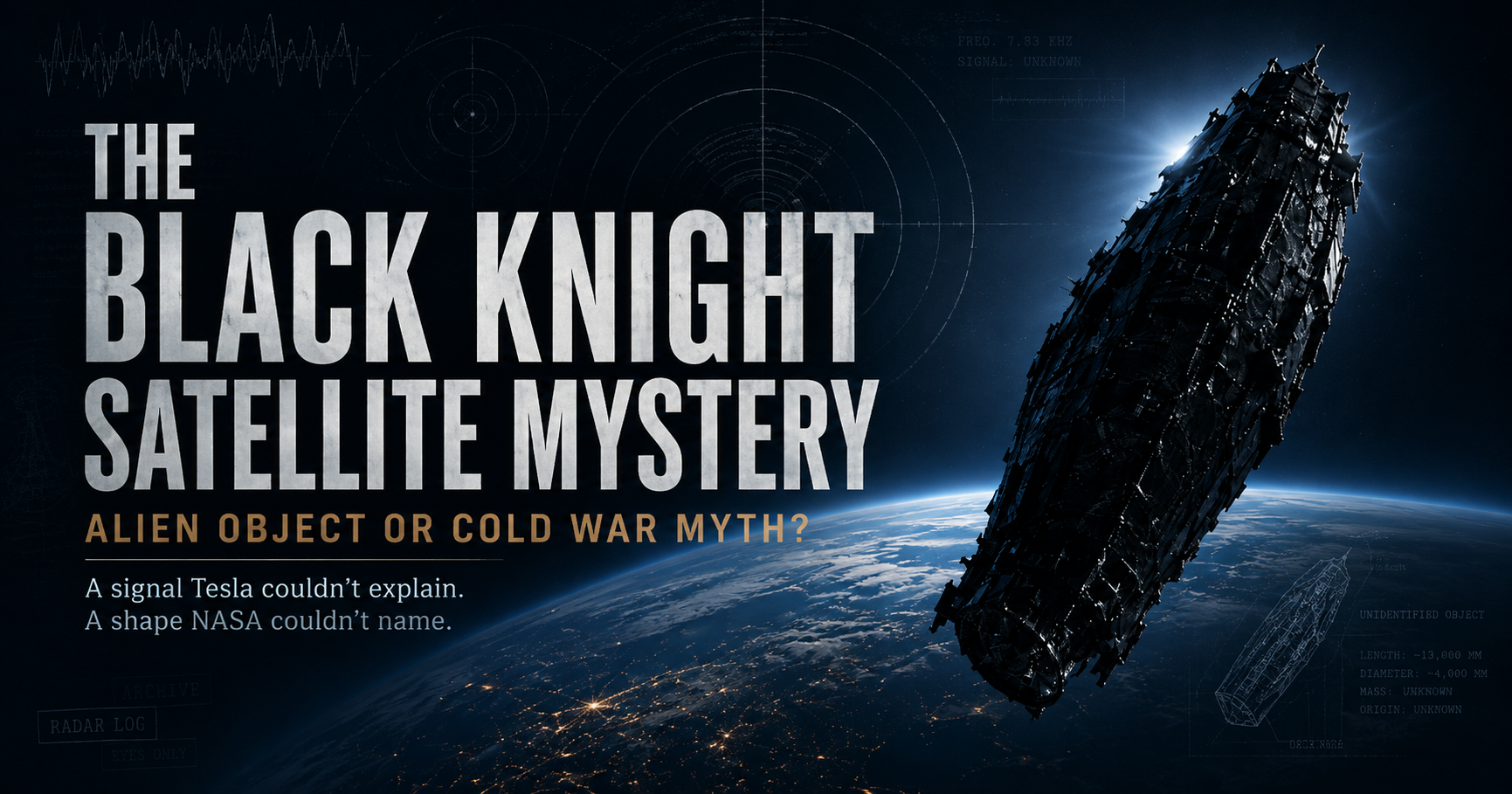
"The sounds were so clear and unmistakable that the impression was forced upon my mind that they must be of intelligent origin." — Nikola Tesla, describing the unidentified radio signals he detected in 1899.
In December 1998, a Space Shuttle astronaut lost a piece of insulation during a spacewalk.
It was an ordinary moment. Thermal blankets come loose. Tools drift away. Anyone who has watched enough EVA footage has seen something tumble silently off into the dark. But this particular blanket, photographed by the crew of STS-88 as it floated near the nascent International Space Station, became — within months — proof of an ancient alien spacecraft.
The image travelled the early internet like wildfire. It was grainy, angular, oddly geometric. It looked, to a generation just learning what the web could do, exactly like what a 13,000-year-old extraterrestrial satellite ought to look like.
It had a name waiting for it: The Black Knight.
A Myth in Pieces
The strangest thing about the Black Knight is that it has no single origin. It is not one story. It is at least six unrelated stories, stitched together across a century by people who wanted them to be the same story.
Year Event What People Heard
1899 Tesla detects strange radio signals at Colorado Springs "Messages from another world"
1928 Norwegian engineer Jørgen Hals records Long Delayed Echoes "A satellite bouncing our signals back"
1954 UFO researcher Donald Keyhoe writes of unknown satellites "The US Air Force is tracking aliens"
1960 TIME magazine reports an unidentified dark object in orbit "It cannot be one of ours"
1973 Researcher Duncan Lunan claims a 13,000-year-old origin "It came from Epsilon Boötis"
1998 STS-88 photographs an object near Endeavour "First clear picture of the Black Knight"
Pull any single thread and it unravels. Braid them together and you have a legend.
The Tesla Signal (1899)
It begins, as so many strange things do, with Nikola Tesla alone in a Colorado laboratory in the summer of 1899.
He was experimenting with high-voltage transmissions when his instruments began registering rhythmic pulses. One. Two. Three. Four. Counted, regular, unmistakably patterned. Tesla wrote that he could not shake the feeling they were not natural — that something, somewhere, was signalling .
What he was almost certainly hearing was atmospheric radio noise: pulsars (not yet discovered), Jovian emissions, or terrestrial lightning. The science of natural radio sources didn't exist yet. Tesla, brilliant but isolated, interpreted the unknown the only way his era allowed — as intelligence from elsewhere.
But he never used the words "Black Knight." That came much, much later.
The Long Delayed Echoes (1928)
Twenty-nine years on, in Oslo , a young Norwegian engineer named Jørgen Hals noticed something that should not have been possible.
He was listening to a Dutch shortwave broadcast when, several seconds after each pulse, an echo came back — sometimes three seconds later, sometimes fifteen, sometimes much more. The signal seemed to be travelling far out into space and returning.
This phenomenon — Long Delayed Echoes (LDEs) — is real and still not fully explained. Modern physics offers several candidates:
Ionospheric ducting
Plasma waves trapped in Earth's magnetosphere
Reflections from the so-called plasmasphere
None of these require a satellite. None of them require aliens. But in 1973, the Scottish researcher Duncan Lunan decided to look at the timing patterns of those 1928 echoes as if they were a message . He plotted the delay intervals on a graph, joined the dots, and announced he saw a star map — pointing to the constellation Boötes , suggesting a probe from a 13,000-year-old civilisation around the star Epsilon Boötis.
Lunan himself walked the claim back within a few years. He has since described the exercise as a thought experiment, not a discovery. By then it didn't matter. The myth had taken his number — 13,000 years — and run with it.
The Headline That Made It Real (1960)
For most of human history, conspiracies needed a journalist to give them shape. The Black Knight got two.
In 1954 , the UFO author Donald Keyhoe told reporters that the US Air Force had detected two satellites orbiting Earth — at a time when neither superpower had launched one. The story was promotional. Keyhoe had a book coming out. The Air Force denied it. The story stuck.
Then, in March 1960 , TIME magazine published a short item titled "Space Watch." It described a mysterious dark object in a near-polar orbit — too heavy to be debris, in a trajectory neither the Americans nor the Soviets had announced.
The object was real.
It was eventually identified as the upper-stage fragment of a Discoverer satellite — part of the classified CORONA spy programme the US could not publicly acknowledge yet. To the unbriefed press, it looked like an alien vessel. To the men inside the National Reconnaissance Office, it was an embarrassing piece of their own hardware they were not yet allowed to talk about.
The Cold War, again, made silence look like proof.
The Photograph (1998)
And then, the picture.
Detail Fact
Mission STS-88, the first Shuttle flight to the ISS
Date 4 December 1998
Photographer Crew of Endeavour
Subject An angular, dark, irregular object drifting near the spacecraft
NASA's identification A thermal blanket lost during astronaut Jerry Ross's EVA
NASA catalogue number 25570 (later re-entered the atmosphere)
The photograph is real. The object is real. Its identity is also documented , in mission logs, in NASA debris-tracking records, and in interviews with the astronauts themselves.
But the image is gorgeous — sinister, geometric, unmoored from any obvious scale — and it arrived on the internet in 1998, a moment when conspiracy folklore was discovering it could now travel faster than correction.
By the early 2000s, the photograph had been retroactively grafted onto Tesla, Hals, Keyhoe, TIME , and Lunan. A century of unrelated curiosities now had a face.
Why the Myth Won't Die
Here is the uncomfortable part.
Every single component of the Black Knight story has been individually explained. Tesla heard natural radio noise. Hals heard ionospheric echoes. Keyhoe was selling a book. TIME was looking at classified American hardware. Lunan was speculating, and said so. The STS-88 object was a thermal blanket.
And yet the legend has only grown.
There are reasons for that, and they are not embarrassing ones:
Cold War secrecy created a habit of disbelief. When governments lied about CORONA, U-2 flights, and Roswell weather balloons, the public learned that the official story was sometimes the cover story. Once trust breaks, it does not return on schedule.
The pieces really are strange. Long Delayed Echoes are still not fully solved. Tesla really did record something. NASA really did photograph an angular object in orbit. The myth survives because its raw material is almost extraordinary.
Humans assemble narratives. Six unrelated curiosities are uncomfortable. One ancient alien satellite is satisfying. The brain prefers the satisfying answer, even when the messy one is correct.
What's Actually Out There
If you want to know what is genuinely circling Earth right now, the answer is more astonishing than any myth:
Over 30,000 tracked objects larger than 10 cm
More than 1 million pieces of debris between 1 and 10 cm
Hundreds of millions of fragments smaller than 1 cm
Dead satellites, lost tools, paint flakes, a glove from a 1965 Gemini spacewalk, a camera Michael Collins fumbled near the Moon
The sky above us is not empty. It is a slow-motion graveyard of human ambition. And somewhere in that swarm of forgotten objects, every few years, a piece of insulation catches the sun at the wrong angle, and we remember to be afraid of the dark again.
The Black Knight may not be alien. But the instinct that built it — that something old, watchful, and not quite ours is up there — is one of the most ancient feelings human beings have. We carried it with us into orbit. And we found, of course, exactly what we brought.