"If anything happens to this launch, I sure as hell wouldn't want to be the person sitting in front of a board of inquiry trying to explain why we launched." — Allan McDonald, Morton Thiokol's Director of the Solid Rocket Motor Project, refusing to sign the launch recommendation on the evening of 27 January 1986.
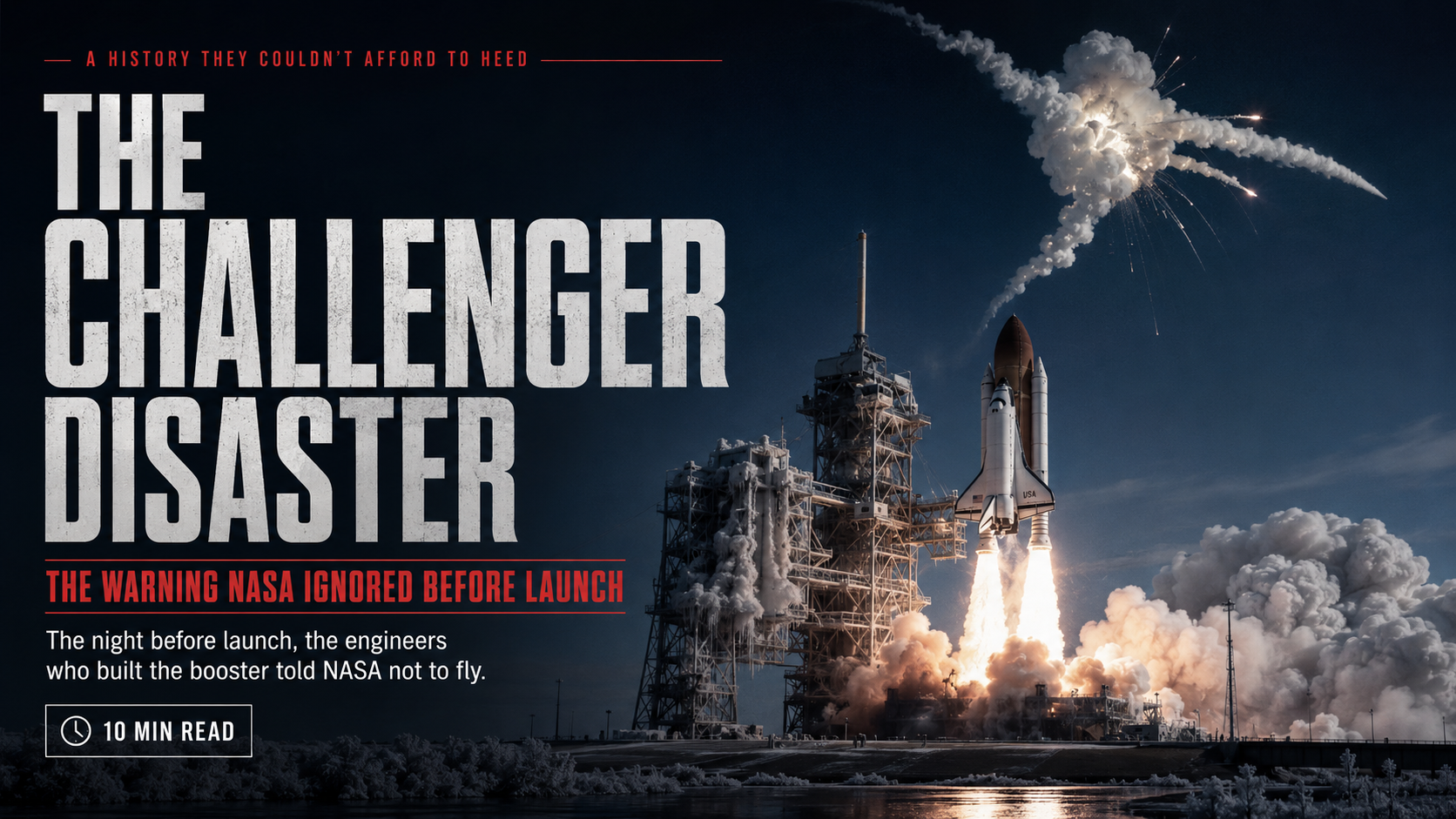
The temperature in Florida the night before the launch dropped to 18 degrees Fahrenheit. Icicles formed on the launch tower. The sea birds went silent. And somewhere in a hotel room thirty miles from the Cape, an engineer named Roger Boisjoly sat on the edge of a bed and wept.
He had spent the evening on a long-distance teleconference, arguing — with senior NASA managers in Florida, Alabama, and Utah — that the Space Shuttle Challenger must not be launched in the morning. He had presented charts. He had cited test data going back to 1977. He had shown them, in plain numerical detail, that the O-ring seals in the Solid Rocket Boosters had never been certified to function in cold weather, that the rubber lost elasticity below about 53 degrees, and that at the temperatures forecast for launch morning, the seals would almost certainly fail.
His own company — Morton Thiokol , the manufacturer of the boosters — had initially agreed with him. Their official recommendation, sent to NASA at 8:45 PM that evening, was: do not launch.
Then NASA had pushed back. Hard. And by midnight, Thiokol's management had reversed itself.
Boisjoly went back to his hotel. He could not sleep. He knew what was going to happen the next morning.
So did three other Thiokol engineers — Bob Ebeling, Arnold Thompson, and Allan McDonald — none of whom slept either. At one point, in the small hours, Ebeling turned to his wife and said quietly: We have just signed the death warrants for those people.
The Mission That Was Already Different
STS-51-L was supposed to be a celebration.
Crew Member Role Distinction
Francis "Dick" Scobee Commander Vietnam combat pilot, second shuttle flight
Michael J. Smith Pilot First spaceflight
Judith Resnik Mission Specialist Second American woman in space
Ellison Onizuka Mission Specialist First Asian-American in space
Ronald McNair Mission Specialist Second African-American in space, MIT-trained physicist
Gregory Jarvis Payload Specialist Hughes Aircraft engineer
Christa McAuliffe Payload Specialist "Teacher in Space" — first civilian astronaut
The presence of Christa McAuliffe was the reason the launch mattered to people who did not normally pay attention to space launches. She was a high school social studies teacher from Concord, New Hampshire, chosen from over 11,000 applicants for President Reagan's Teacher in Space programme. She was going to broadcast two lessons from orbit to American classrooms. Her students were already gathered around television sets across the country, watching the countdown live.
There was also a political deadline, of course. There always was.
President Reagan was scheduled to deliver his State of the Union address that evening, 28 January 1986. White House staff had quietly indicated that a successful launch — with the first teacher in orbit — would feature in the speech. NASA had been delayed on Challenger for four days already, suffering through one scrub after another. Senior administrators wanted the shuttle in the air before sunset.
That pressure did not, technically, cause the disaster. But it formed the backdrop against which the engineering arguments of the previous night took place.
The Conference Call That Killed the Crew
The teleconference began at approximately 8:45 PM Eastern Time on 27 January 1986. On the line were:
Thiokol engineers and managers at the company's Utah facility
NASA Marshall Space Flight Center managers in Huntsville, Alabama
NASA Kennedy Space Center launch personnel in Florida
Boisjoly led the technical presentation. He had been studying the O-ring problem for nearly a decade. His central point was simple:
In the coldest previous shuttle launch — STS-51-C in January 1985, at 53°F — the O-rings had shown the worst erosion ever documented. Tomorrow's launch was forecast at 26°F. We are off the chart.
He showed photographs. He showed cross-sections of damaged seals. He explained that the rubber, when cold, took longer to expand into the gap it was meant to seal — and during that brief lag, hot combustion gases could blow past it. Blow-by , the engineers called it. At 53°F, they had seen blow-by. At 26°F, they did not know what they would see, because no shuttle had ever launched that cold and no test had ever been done.
Thiokol's official recommendation, signed by senior engineer Robert Lund, was issued formally at the end of the technical brief:
"Do not launch below 53°F."
The line went quiet. Then Lawrence Mulloy , NASA's Marshall manager for the Solid Rocket Boosters, said the sentence that would echo through every aerospace investigation for the next forty years:
"My God, Thiokol. When do you want me to launch? Next April?"
What happened next is documented in the Rogers Commission report in exhaustive detail.
Time Event
~10:00 PM NASA managers express "appall" at Thiokol's recommendation
~10:30 PM Thiokol requests an off-line caucus to reconsider
~10:30–11:30 PM Internal Thiokol discussion; engineers reaffirm their position
~11:00 PM Jerry Mason, Thiokol VP, tells engineer Robert Lund: "Take off your engineering hat and put on your management hat."
~11:30 PM Four Thiokol VPs vote — over the objections of every engineer in the room — to reverse the recommendation
~11:45 PM Allan McDonald refuses to sign the new launch recommendation. Mason signs it instead.
~12:00 AM Thiokol formally tells NASA: Launch is acceptable.
The engineers had been overruled. The launch was on.
What is worth noting — what the Rogers Commission would later highlight repeatedly — is that NASA's upper management was never informed that this argument had taken place . The chain of command at Kennedy Space Center, including the launch director, was told only that Thiokol had given the all-clear. The dissent had been managed internally , by the people whose careers depended on the launch proceeding.
The Morning
At 8:36 AM on 28 January 1986, ice still coated the launch pad gantries. Inspectors had been chipping it away for hours. Pad temperature at launch was approximately 36°F . The O-rings inside the right-hand Solid Rocket Booster were, by best estimates, at about 28°F when ignition occurred.
At T+0.678 seconds, smoke puffs were visible from the aft field joint of the right SRB.
Nobody on the ground saw them in real time.
At T+58 seconds, a small flame became visible at the same joint.
At T+64 seconds, the flame penetrated the External Tank.
At T+73 seconds, the External Tank ruptured. The shuttle, travelling at nearly twice the speed of sound, was torn apart by aerodynamic forces — not , despite popular memory, by an explosion. The orbiter broke into recognisable pieces. The crew cabin, mostly intact, was thrown clear of the disintegrating stack and continued upward for another twenty-five seconds, reaching an altitude of about 65,000 feet before beginning its long fall.
The cabin hit the surface of the Atlantic Ocean at approximately 207 miles per hour , two minutes and forty-five seconds after launch.
The Question Nobody Wants Answered
For nearly two years, the official NASA position was that the crew had died instantly when the orbiter broke apart.
This was not true. NASA knew it was not true within weeks of the disaster. The physical evidence recovered from the ocean floor told a more difficult story.
Three of the four Personal Egress Air Packs (PEAPs) — emergency air supplies on the back of each crew seat — were found in the activated position. These could only have been switched on manually, by another crew member, after the orbiter broke up. Michael Smith's PEAP, in particular, was activated from a switch he could not have reached himself.
This meant that at least some of the crew were conscious in the seconds after the breakup, conscious enough to perform the trained procedure of switching on one another's emergency air.
What is not known — what cannot be known — is whether they remained conscious during the two-and-a-half-minute fall. The cabin's loss of pressure at altitude would have caused rapid hypoxia. Most aerospace medical experts believe the crew lost consciousness within seconds of the breakup. A minority disagrees.
We do not know if the seven astronauts of Challenger were aware of what was happening in the long, silent descent toward the ocean. We know only that someone, in those first seconds, kept the procedure. They reached for the switches behind their colleagues' heads. They tried.
Feynman, an Ice Cube, and the End of NASA's Innocence
The Rogers Commission — appointed by President Reagan and chaired by former Secretary of State William Rogers — investigated the disaster from February to June 1986. Its members included Neil Armstrong, Sally Ride, and the physicist Richard Feynman , who would prove to be the most consequential member of the panel.
Feynman, then in the late stages of cancer, was openly impatient with the political theatre of the commission's televised hearings. He believed the agency was being permitted to defend itself with vague language. So at one hearing, during a discussion of the O-rings, he reached into a glass of ice water on the witness table, pulled out a small piece of the same rubber compound used in the seals, and squeezed it with a C-clamp he had brought from his hotel.
When he released it, the rubber did not spring back. It had lost its elasticity in seconds.
Feynman looked at the cameras and said, with the tone of a man explaining something he was tired of explaining: I believe that has some significance for our problem.
It was one of the most devastating moments in the history of American public investigation. In thirty seconds, with a household clamp and a glass of ice water, a physicist had demonstrated on live television exactly why the Challenger crew had died.
Feynman's separate appendix to the Rogers Report — known as Appendix F: Personal Observations on the Reliability of the Shuttle — closed with one of the most quoted sentences in engineering ethics:
"For a successful technology, reality must take precedence over public relations, for nature cannot be fooled."
The Findings
The Rogers Commission's conclusions, delivered in June 1986, were unambiguous.
Finding Substance
Cause of failure O-ring seal failure in the right SRB aft field joint, caused by cold-temperature loss of elasticity
Underlying organisational cause A "flawed decision-making process" that allowed mid-level managers to suppress engineering dissent
Schedule pressure NASA had increasingly come to treat shuttle launches as routine commercial operations rather than experimental flights
Internal communication Upper management was not informed of Thiokol's objections; the dissent was contained at the level that had a vested interest in containing it
Safety culture Compromised by years of operating "outside the experience base" without acknowledging the accumulating risk
The shuttle fleet was grounded for 32 months . The SRBs were redesigned with an additional O-ring and joint heater. Crew escape provisions — eject seats had been removed after STS-4 — were partially restored. Thirty-two billion dollars (in 2024 terms) was spent on changes to the programme.
And yet, seventeen years later, the Columbia disaster would reveal that many of the cultural lessons of Challenger had been quietly unlearned.
The Engineers Who Were Right
Roger Boisjoly never returned to Morton Thiokol in any senior capacity. He suffered crippling post-traumatic stress, depression, and headaches. He testified to the Rogers Commission against the explicit wishes of his employer. He became an ethics lecturer at engineering schools, telling his story to audiences of young engineers for the next twenty-five years. He died in 2012.
Allan McDonald, who refused to sign the launch recommendation, was demoted at Thiokol after the disaster. Congressional intervention later restored his position. He went on to write the definitive insider memoir of the disaster, Truth, Lies, and O-Rings , published in 2009. He died in 2021.
Bob Ebeling — the engineer who told his wife they had signed the crew's death warrants — was haunted for the rest of his life. In 2016, on the thirtieth anniversary of the disaster, he gave an interview to National Public Radio in which he said he had never forgiven himself for not stopping the launch. He believed God had picked him for the role and he had failed.
NPR's listeners flooded him with messages. So did NASA officials and aerospace engineers across the world. He died three weeks after the interview, at age 89, having received — too late — the public absolution his employer had spent thirty years refusing to give him.
The Lesson Already On File
What killed the Challenger crew was not a freak weather event, not an unforeseeable engineering anomaly, not a one-in-a-million failure of materials science. The exact failure mode had been documented in writing. The exact temperature threshold had been identified. The exact engineers raising the exact concern had presented their case, formally, with charts and data, less than twelve hours before the launch.
What overrode them was a managerial process designed to deliver a flight schedule. The engineers were not ignored because their analysis was wrong. They were ignored because their analysis was inconvenient — and because the institutional structure of NASA in 1986 permitted a small number of mid-level managers, under pressure to meet a launch window, to filter out the voices that would have stopped them.
Seven astronauts died because seven different management decisions, each individually defensible, combined into a chain whose final link was a rubber seal in the cold. That is not how disasters are usually told. We prefer them to have villains. The Challenger has none. It has only the slow, ordinary accumulation of compromises that any large organisation, given enough time and enough pressure, will produce.
Roger Boisjoly told them. Allan McDonald told them. Bob Ebeling told them. They had been telling NASA, in some form, for nearly a decade. And on the night of 27 January 1986, in a hotel room near the Cape, an engineer sat on the edge of a bed and wept, because he had told them again, and again it had not been enough.
Related Notes / Sources Consulted
Rogers Commission Report — Report of the Presidential Commission on the Space Shuttle Challenger Accident (June 1986). The primary investigative document, including witness testimony and technical analysis.
Feynman, Richard P. Appendix F: Personal Observations on the Reliability of the Shuttle — Feynman's separate dissenting appendix to the Rogers Report.
Feynman, Richard P. What Do You Care What Other People Think? (W.W. Norton, 1988) — first-hand account of the investigation by the physicist whose ice-water demonstration became iconic.
McDonald, Allan & Hansen, James. Truth, Lies, and O-Rings: Inside the Space Shuttle Challenger Disaster (University Press of Florida, 2009) — definitive insider account.
Vaughan, Diane. The Challenger Launch Decision: Risky Technology, Culture, and Deviance at NASA (University of Chicago Press, 1996) — sociological analysis of the "normalisation of deviance" within NASA's decision-making.
NPR All Things Considered , February 2016 — Bob Ebeling's anniversary interview.
NASA History Office — STS-51-L mission files and Rogers Commission archival materials.
U.S. Congressional Hearings, House Committee on Science and Technology , 1986 — testimony from Roger Boisjoly, Allan McDonald, and other Thiokol engineers.
Editorial note: Every technical and personnel detail in this article is drawn from published, on-the-record investigative material. Quoted statements are from sworn testimony or attributed memoir. The reconstruction of the 27 January teleconference follows the chronology established by the Rogers Commission and corroborated by McDonald's memoir.