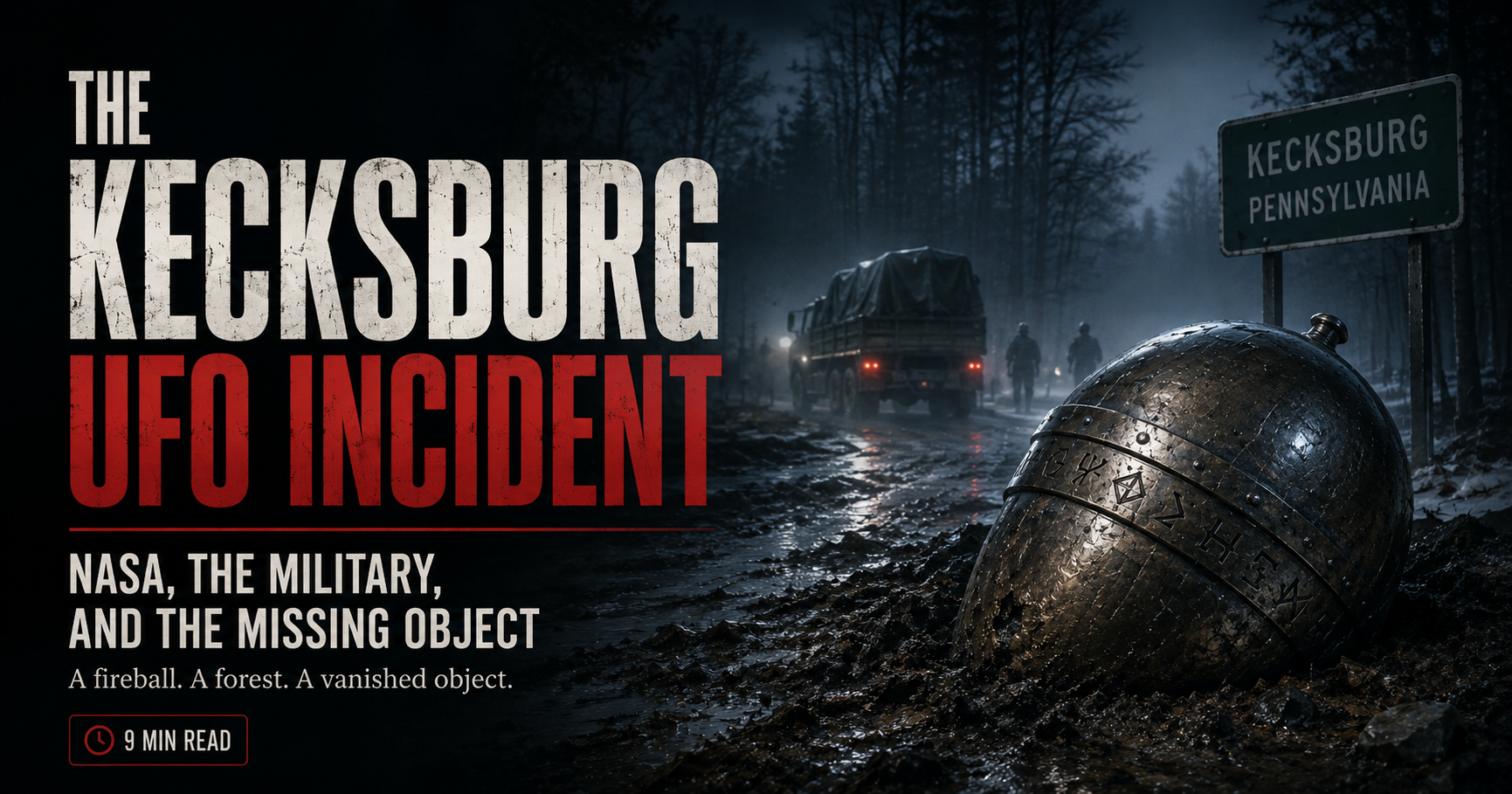
"It was about the size of a Volkswagen. Bronze. Shaped like an acorn. And there was writing on it — like hieroglyphics, but not." — Jim Romansky, volunteer firefighter and one of the first civilians to reach the impact site, recalling the night of 9 December 1965.
It was a Thursday evening, just before sunset, when the sky over six American states caught fire.
Drivers in Michigan pulled over to watch a brilliant fireball streaking south. Pilots over Ontario radioed in sightings. In Detroit, a police officer reported what looked like burning debris. In Cleveland, the National Weather Service registered sonic anomalies. By the time the object passed over Kecksburg, Pennsylvania — a quiet village of fewer than two hundred souls — residents would later swear they heard it slow down.
Slow down, change course, and land .
Within ninety minutes, the woods south of the village were sealed by men in uniform. By dawn, the object — if there had been an object — was gone. So were the witnesses' notes. So, eventually, were the official records.
What happened at Kecksburg in those twelve hours is one of the most thoroughly investigated, least successfully explained incidents in the history of American aerospace. It is sometimes called the Roswell of the East . The comparison is unfair to both events. Kecksburg is stranger, because Kecksburg is better documented .
A Timeline of That Evening
Time (EST) Event
4:43 PM First fireball sightings reported across Michigan and Ontario
4:47 PM Object tracked over Ohio, descending; sonic booms heard
4:50 PM Witnesses in Kecksburg, PA report an object descending into woods east of the village
5:00 PM Local fire department dispatched; chief James Mayes among first on scene
5:30 PM Pennsylvania State Police arrive; area begins to be cordoned
6:30 PM US Army personnel arrive from a nearby base — uniformed soldiers, armed
7:00 PM Press and civilians turned away at the perimeter
Late evening A flatbed truck enters the woods; witnesses report it leaving carrying a tarp-covered object
10 December 1965 Military issues a statement: "Nothing was found."
The contradiction is what built the legend. Why send armed troops to recover nothing? Why cordon a forest to protect an absence?
What the Witnesses Said
Multiple townspeople reached the impact site before the military secured it. Their accounts, gathered over the following decades by journalists and researchers, are remarkably consistent for a story that was supposed never to have happened.
The object was described as:
Acorn-shaped , roughly the size of a small car
A burnished bronze or copper colour , dulled and warm to look at
Banded near its base with markings — "like ancient hieroglyphics" , said one witness; "like Egyptian or Sanskrit, but not either," said another
Embedded into the soil at an angle, as though it had been steered into landing, not crashed
The fire chief, James Mayes , would later tell investigators that the object did not look like wreckage. He said it looked like a vehicle .
"It wasn't a meteorite. I've seen meteorites. This had a shape. It was made." — James Mayes, in a 1990s interview shortly before his death.
The military, when it arrived, did not act like men recovering a rock.
?? The Official Story — and Its Holes
The position of the United States government has remained, for sixty years, essentially the same:
Nothing was recovered. The fireball was a meteor. The military presence has been exaggerated. There are no records.
Almost every part of that statement has been challenged.
Claim Problem
"It was a meteor." Meteors do not change trajectory mid-flight. Multiple radar and visual reports describe lateral movement.
"There was no military recovery." Photographs exist of Army trucks in the area. Soldiers' own families have given interviews.
"No records exist." NASA, in court filings in 2007, admitted that some records on the incident had been lost — without explaining how.
"There was nothing to find." Witnesses, including law enforcement and trained firefighters, have never recanted.
The Real Candidates
If something genuinely came down at Kecksburg, what was it? Serious investigators have narrowed the field to four possibilities — three terrestrial, one not.
1. Kosmos 96 — A Soviet Venus Probe
In November 1965, the USSR launched Kosmos 96 , a probe intended for Venus. The launch failed; the spacecraft was left in a decaying Earth orbit and is widely believed to have re-entered the atmosphere later that year.
For decades, NASA scientists — including astronomer Nicholas L. Johnson , the agency's later chief orbital debris expert — calculated whether Kosmos 96 could have come down over Pennsylvania on the evening of 9 December.
The conclusion: the timing does not quite match. Kosmos 96 is believed to have re-entered earlier in the day, over Canada. But the orbital data from 1965 was imprecise, and "does not quite match" is not the same as "could not have happened."
If it was Kosmos 96, the secrecy makes perfect sense. Recovering a Soviet probe — intact, with its instruments and possibly its film — would have been one of the great intelligence coups of the Cold War. The United States would not have announced it. The Soviet Union, having lost a failed mission, would never have asked.
2. A CORONA / Discoverer Film Capsule
The CORONA programme — the CIA's classified spy-satellite project — was active in 1965, returning film capsules from orbit by parachute over the Pacific. Capsules occasionally went off-course. A misfired re-entry could plausibly have brought one down over the eastern United States.
This would also explain the military's speed: only a small number of officers in 1965 even knew CORONA existed. A wayward capsule had to be recovered before anyone — press, civilians, the Soviets — could photograph the markings.
3. The General Electric Re-entry Vehicle Test
Some declassified material suggests the US was experimenting in the mid-1960s with General Electric Mark 2 re-entry vehicle prototypes for nuclear warhead delivery. An acorn-shaped, heat-shielded blunt-body design was, in fact, a hallmark of that programme. A test article gone astray would have been classified at the highest levels.
4. Genuinely Unidentified
And then, of course, there is the answer the witnesses themselves favoured. Not a probe. Not a capsule. Not a warhead nose-cone.
Something else.
The Lawsuit That Forced NASA to Look
The story would have faded — most do — were it not for an investigative journalist named Leslie Kean and her years-long Freedom of Information Act campaign against NASA.
Year Development
2003 Sci-Fi Channel funds a fresh independent investigation, including ground-penetrating radar scans of the impact site
2007 Kean files a federal lawsuit against NASA for withholding records
2009 Federal court orders NASA to conduct a thorough search of its archives
2009 (later) NASA admits it cannot locate two boxes of relevant documents from the 1960s
NASA's own words, in court: the records appear to have been lost.
In an agency that catalogues every screw on every satellite, two missing boxes — specifically the two boxes pertaining to a publicly disputed 1965 recovery — is an answer that sounds less like bureaucracy and more like an apology.
What the Forest Still Holds
Today, the village of Kecksburg has a fibreglass replica of the object mounted behind the firehouse. Tourists photograph it. The town holds a small annual festival. The acorn shape, the bronze finish, the band of mysterious symbols — all reconstructed from witness sketches, all available to anyone who wants to drive into Westmoreland County and stand beside something that may or may not have ever existed.
The woods themselves have grown back over the impact site. There is nothing to see. There has not been, for sixty years.
But the people who were there that night — the firefighters, the police, the children who watched military trucks roll past their homes — most of them are now in their eighties and nineties. Some have died holding to their story. None has recanted.
Somewhere in a warehouse, or a hangar, or a lost cardboard box, sits the answer. Whether it is a Soviet probe, an American secret, or something neither government would know how to file — it is, almost certainly, still there. The United States does not throw such things away. It only loses the paperwork.
Related Notes / Sources Consulted
Kean, Leslie. UFOs: Generals, Pilots, and Government Officials Go on the Record (Harmony Books, 2010) — includes a substantial chapter on the Kecksburg FOIA lawsuit and NASA's admission of lost records.
Sci-Fi Channel Investigation (2003) — The New Roswell: Kecksburg Exposed , ground-penetrating radar survey and witness interviews.
Johnson, Nicholas L. — Soviet space-debris re-entry analysis (NASA Orbital Debris Programme historical records).
National Reconnaissance Office (NRO) — declassified CORONA programme files (released 1995).
Pittsburgh Post-Gazette archives, December 1965 — original local reporting of the incident.
Westmoreland County, PA — fire department and police logs from 9 December 1965.
Court filings, Kean v. NASA , US District Court, 2007–2009.
Editorial note: This article distinguishes between documented facts (the fireball was real, the military response is on the record, NASA's lost records are confirmed in court filings) and contested interpretation (what the recovered object was, or whether anything was recovered at all). The mystery at Kecksburg is not whether something happened — it is what.