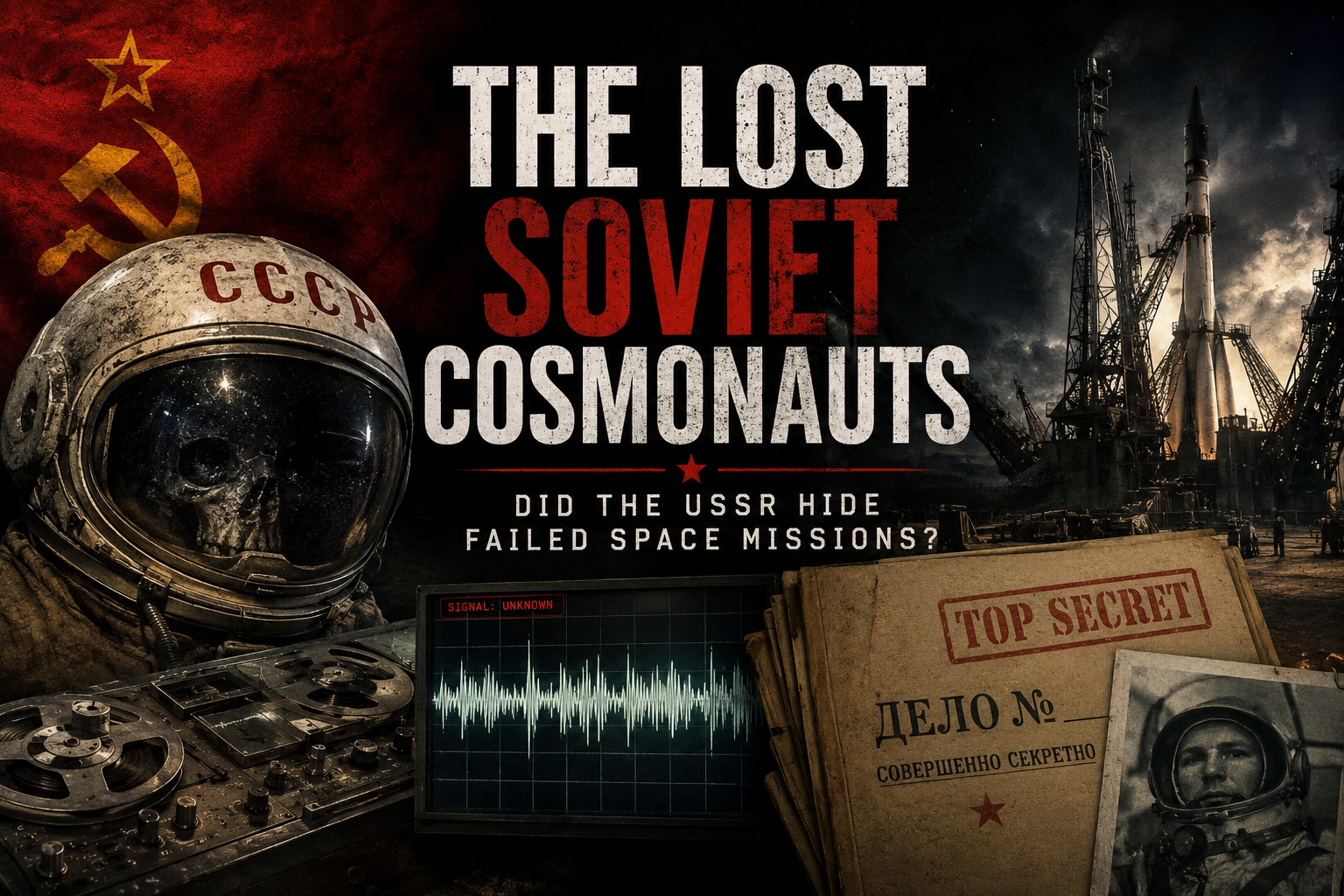
"It's hot… the flames are coming… won't you talk to me?" — Translated fragment of a transmission allegedly recorded by the Judica-Cordiglia brothers, May 1961.
There is a recording, just under forty seconds long, that sounds like a woman dying.
Her voice is faint, swallowed by static, but the panic is unmistakable. She says, in Russian, that it is hot — that the flames are coming, that she can see them. She calls out for someone to talk to her. Then the carrier wave thins, and she is gone.
The tape was made by two young brothers named Achille and Giovanni Judica-Cordiglia , who had built an amateur listening station in an abandoned German bunker outside Turin. They had no political agenda. They were teenagers with soldering irons, a war-surplus antenna, and an obsession with the sky. And in the years between 1960 and 1965, they say, they captured the last transmissions of cosmonauts the Soviet Union pretended never existed.
The Official Story — and What It Leaves Out
The public history of Soviet spaceflight reads like a victory parade:
Yuri Gagarin — first man in orbit, April 1961
Valentina Tereshkova — first woman in space, June 1963
Alexei Leonov — first spacewalk, March 1965
A neat, bright chain of firsts. Each one a hammer-blow against American confidence.
But behind that chain, archivists and dissidents have long whispered of another history — one written in scorched metal, sealed files, and names edited out of photographs.
A System Built to Forget
To understand why the Lost Cosmonauts theory took root, you have to understand how the Soviet space programme actually operated.
Aspect Reality
Run by The military, not a civilian agency
Chief Designer's identity Sergei Korolev — a state secret until his death in 1966
Failure policy Unannounced. Often unacknowledged for decades.
Personnel records Edited. Faces airbrushed from group photos.
This is not conspiracy theory. It is documented fact.
When cosmonaut Grigori Nelyubov was expelled from the corps in 1963, he was erased from the famous Sochi Six photograph — airbrushed into nothing, like Stalin's purged generals. He drank himself to ruin and walked in front of a train three years later. Two other expelled trainees, Ivan Anikeyev and Valentin Filatyev, suffered similar editorial deaths long before their physical ones.
If the regime could erase men who were merely embarrassing — what might it have done with men who were tragic?
The Brothers Who Listened
The Judica-Cordiglia brothers were not cranks.
Italian newspapers of the early 1960s photographed them at their equipment.
Western intelligence services took their work seriously enough to request copies.
They had legitimately recorded Sputnik's beeping signal.
They had captured Gagarin's heartbeat transmission in 1961.
Their station, Torre Bert , was real, well-equipped, and stubbornly turned toward the east.
What they claimed to hear between the announced flights is what makes the hairs rise on the back of the neck:
Date Alleged Transmission
Nov 1960 A man's voice repeating SOS in Morse, signal fading as his orbit decayed
Feb 1961 The strained breathing of a cosmonaut suffocating — two months before Gagarin
May 1961 The dying woman in the burning craft
1962 A three-person crew tumbling out of orbit — voices arguing, begging, then silent
1964 A final transmission so distorted it sounds barely human
The Soviet Union denied all of it. Western governments, by and large, declined to push the question. The Cold War had its own etiquette: you did not embarrass the other side over its dead, because you had your own dead to worry about.
The Names That Won't Go Away
Around the recordings, a folklore began to assemble itself. The names are spoken almost as incantations on certain corners of the internet:
Ledovsky. Shaborin. Mitkov. Gromova. Belokonev.
None appear in any verified Soviet roster. Most likely they are inventions — products of mistranslation, propaganda, or a 1959 Czech magazine article that fabricated a list of casualties for reasons no one has ever fully explained.
But two names refuse to dissolve so easily.
1. Vladimir Ilyushin — The Pilot Before Gagarin?
In April 1961, the British communist newspaper The Daily Worker — of all places — reported that Ilyushin had flown into space three days before Gagarin and crashed on re-entry, surviving but in a coma.
The Soviet response was a hospital photograph of Ilyushin recovering from a car accident.
He went on to live a long, decorated life as a test pilot. He never spoke publicly about the rumour. He died in 2010. The rumour outlived him.
2. Valentin Bondarenko — The One That Is True
This story breaks your heart, because it is true .
Age: 24
Status: Member of the original cosmonaut group
Date: 23 March 1961 — three weeks before Gagarin's flight
Location: Low-pressure oxygen chamber, Moscow
He dropped an alcohol-soaked cotton swab onto an electric hot plate. The pure-oxygen atmosphere turned the chamber into a furnace. It took half an hour to open the door, because the pressure had to be equalised first.
He lived for sixteen hours. His body was so burned that the only places a nurse could find to inject morphine were the soles of his feet.
The Soviet Union did not acknowledge his death for twenty-five years .
His name was scrubbed from cosmonaut group photographs.
His wife was relocated.
His existence became, for a quarter of a century, an administrative inconvenience that simply was not .
If they could do that to Bondarenko — who else?
What We Know vs. What We Don't
Modern historians, working with partially-opened Russian archives from the 1990s, have reached a careful consensus.
Confirmed Soviet Space Fatalities
Mission Year Crew Cause
Soyuz 1 1967 Vladimir Komarov Parachute failure on re-entry; impacted ground
Soyuz 11 1971 Dobrovolski, Volkov, Patsayev Cabin depressurisation; asphyxiation
Training accident 1961 Valentin Bondarenko Fire in oxygen chamber
Komarov reportedly cursed the engineers as he fell. The Soyuz 11 crew were found still strapped to their seats, looking peaceful, as if asleep.
Contested or Unverified
The Torre Bert recordings
Ilyushin's alleged pre-Gagarin flight
The apocryphal name lists (Ledovsky, Mitkov, etc.)
Most serious researchers — including American historian James Oberg , who has spent decades methodically dismantling the wilder Lost Cosmonaut claims — believe the official ledger is broadly accurate. Concealing an entire orbital launch, complete with tracking signatures visible to NORAD, would have required a conspiracy of impossible scale.
And yet…
The recordings exist.
The airbrushed photographs exist.
Bondarenko existed, was hidden, and is no longer hidden only because the system that hid him collapsed.
The Nedelin catastrophe of 1960 — in which over a hundred engineers and military personnel were incinerated on a launchpad at Baikonur — was concealed for nearly three decades. When the truth came out, it was worse than the rumours had been.
The Shape of the Silence
So when someone plays you the Turin recording — the woman, the heat, the static — you cannot quite dismiss it with the confidence you would like to have.
You can say:
Probably a hoax. Probably a misidentified signal. Probably a propaganda construction by two clever Italian boys.
Probably.
But you are listening to a voice that may have been the last sound a human being ever made — alone, on fire, in the dark above the Earth. And the country that put her there said nothing. Has said nothing. May never say anything at all.
That is the real legacy of the Lost Cosmonauts. Not certainty, but the shape of the silence — the suspicion that history's ledger is missing pages, and that somewhere, in a sealed file or a forgotten reel of tape, the names of the dead are waiting for someone who still cares enough to look.
Related Notes / Sources Consulted
Oberg, James. Uncovering Soviet Disasters: Exploring the Limits of Glasnost (Random House, 1988) — the foundational sceptical examination of Lost Cosmonaut claims.
Siddiqi, Asif A. Challenge to Apollo: The Soviet Union and the Space Race, 1945–1974 (NASA SP-2000-4408) — the definitive scholarly account, drawing on post-Soviet archival releases.
Burgess, Colin & Hall, Rex. The First Soviet Cosmonaut Team: Their Lives, Legacy, and Historical Impact (Springer-Praxis, 2009) — detailed biographies including the rehabilitation of Bondarenko's record.
Hardesty, Von & Eisman, Gene. Epic Rivalry: The Inside Story of the Soviet and American Space Race (National Geographic, 2007).
The Judica-Cordiglia archive recordings — partial collections held by RAI (Italian state broadcaster); discussed in BBC documentary coverage of Torre Bert.
The Daily Worker (UK), April 1961 — primary source for the original Ilyushin rumour.
Russian State Archive (RGANTD) — declassified materials on the Nedelin catastrophe, released in the 1990s.
Editorial note: This article distinguishes between verified historical record (Komarov, Soyuz 11 crew, Bondarenko, Nelyubov's erasure, Nedelin) and contested or unverified claims (the Turin recordings, Ilyushin's alleged flight, the apocryphal name lists). Readers should treat the latter as folklore worth investigating, not established fact.