"The tapes were recorded over. It was a mistake. There's no way to recover them." — Dick Nafzger, NASA engineer who led the agency's 2006–2009 search for the original Apollo 11 telemetry tapes.
On the night of 20 July 1969, an estimated 650 million people — roughly one in five human beings then alive — sat in front of television sets and watched a ghost descend a ladder onto the surface of the Moon.
The image was terrible.
It was smeared, low-contrast, blown-out in places and almost black in others. Neil Armstrong was a white silhouette against a paler grey background, his movements stuttering, his face invisible. People squinted. People cried anyway. We are watching a man walk on the Moon, they thought, and they forgave the picture quality, because what else could they do.
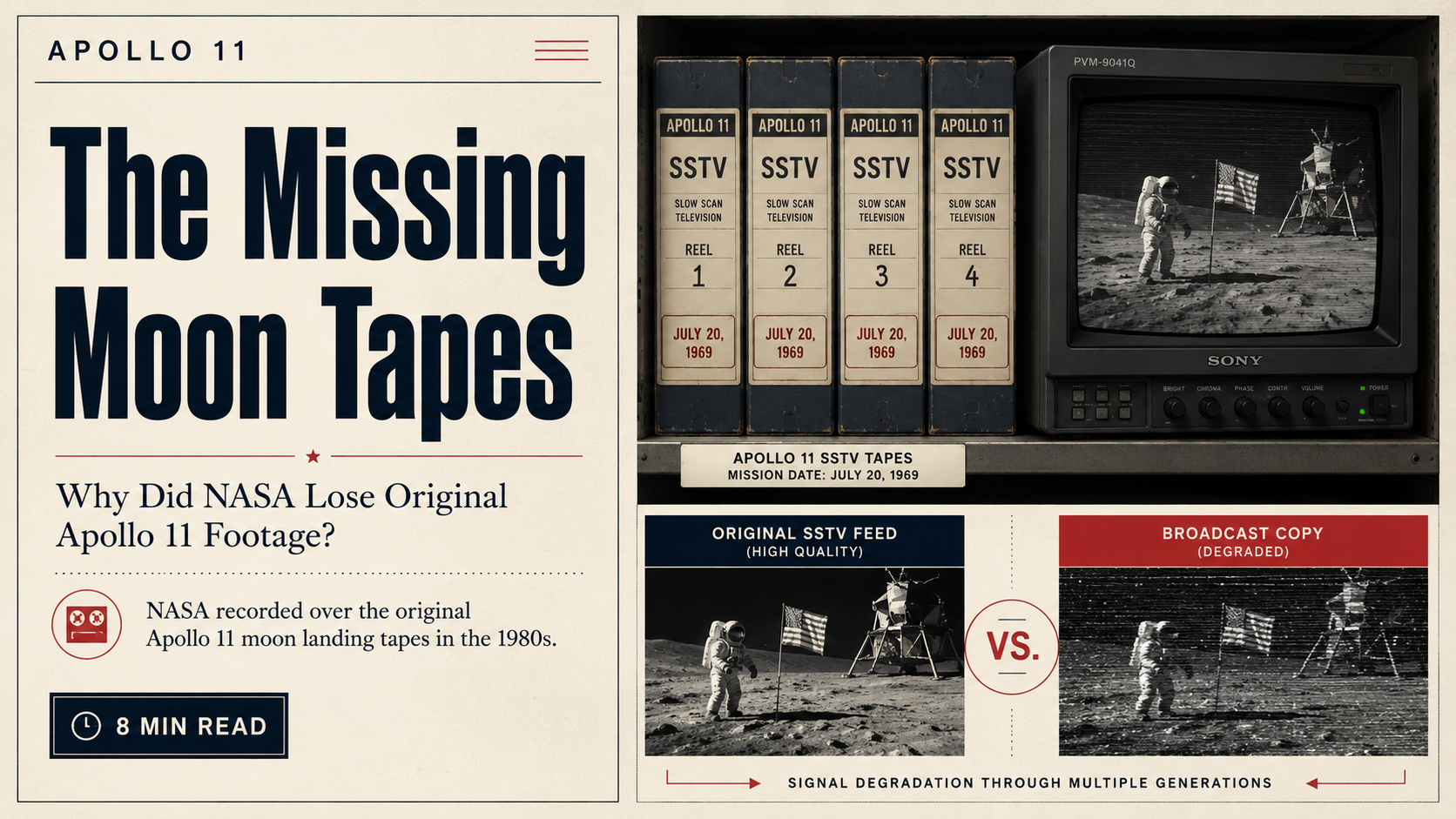
What none of those 650 million viewers knew — what almost none of them know to this day — is that the broadcast they were watching was already a degraded copy . The real footage, the original recording , was at that very moment being captured on magnetic tape at three tracking stations on two continents, in a format vastly clearer than anything reaching their living rooms.
Those original tapes existed. They were catalogued. They were stored.
And then, sometime in the 1980s, NASA quietly recorded over them.
The Technical Reason the Broadcast Looked So Bad
To understand what was lost, you first have to understand what was captured .
The Apollo 11 lunar camera used a format called Slow-Scan Television (SSTV) . SSTV was chosen because the lunar module's communication systems could not transmit the data volume of a normal television signal. It was, essentially, a compromise.
Feature SSTV (Lunar Original) NTSC (US Broadcast)
Frame rate 10 frames per second 30 frames per second
Resolution 320 scan lines 525 scan lines
Bandwidth required Low High
Compatible with home TVs? No Yes
Because SSTV could not be displayed on standard televisions, NASA's broadcast engineers had to convert it in real time. Their solution was almost comically analogue: they pointed a normal TV camera at a monitor displaying the SSTV feed , and broadcast what the second camera saw.
That conversion stripped most of the detail. The image you remember — the one your parents or grandparents wept over — was a picture of a picture , blurred twice over by the conversion process and a third time by transmission to home aerials.
The original SSTV feed, by contrast, was sharper, brighter, and showed Armstrong as a recognisable human figure rather than a glowing smear.
That is what the tracking stations recorded, on one-inch magnetic data tape , at three locations:
Goldstone Deep Space Communications Complex , California
Honeysuckle Creek Tracking Station , Australia
Parkes Radio Observatory , Australia (later took over from Honeysuckle for most of the EVA)
The tapes were boxed, labelled, and sent — along with thousands of other telemetry reels from across the Apollo programme — to a storage facility at Goddard Space Flight Center in Greenbelt, Maryland.
There were roughly 1,150 reels in the Apollo collection.
They sat in their boxes for fifteen years.
The Erasure That Nobody Decided to Make
Here is where the story stops being technical and starts being human.
By the early 1980s, NASA was facing a problem that had nothing to do with the Moon. The agency was running out of magnetic tape.
The specific reels Goddard used to store Apollo data were expensive, specialised, and no longer being manufactured in the quantities NASA required . New deep-space missions — Voyager, the early shuttles, planetary probes — needed somewhere to record their incoming data. And right there, in a climate-controlled archive at Goddard, sat fifteen years' worth of apparently obsolete tapes from a programme that had ended in 1972.
There was no single moment of decision. There was no order from on high. There was, instead, the quiet daily routine of an under-resourced records department working its way through a shelf of old reels, degaussing them, relabelling them, and putting them back into rotation.
Nobody woke up one morning and said: erase the Moon landing. The Moon landing was erased the way most cultural treasures are lost — not by malice, but by the slow attrition of a budget line, a logistics decision, and the assumption that someone else, somewhere, must have a copy.
By the time NASA realised what had happened, the originals were gone. There is no surviving inventory of exactly which tapes were erased on which day. There is only the absence.
The 2006 Search
The story would have stayed buried, perhaps indefinitely, if a small group of retired engineers and Apollo veterans had not started asking, in the mid-2000s, where the originals had ended up.
The driving force was an Australian named John Sarkissian , an operations scientist at the Parkes Observatory. He had been involved in the 2000 film The Dish , a comedic dramatisation of Parkes's role in the broadcast, and the research had left him obsessed with one question: the original SSTV tapes — they must still exist. Where are they?
He began a years-long correspondence with retired NASA engineers, archivists, and the small community of people who had handled the reels in the 1970s. He compared logs. He chased down obsolete tape-deck specifications. He visited Goddard.
In 2006 , the search became official. NASA convened a team led by retired engineer Dick Nafzger , who had personally been involved in the original 1969 broadcast operations. They searched Goddard. They searched the National Archives. They searched private collections, surplus auctions, and forgotten warehouses.
For three years, they searched.
In July 2009 , on the eve of the fortieth anniversary of the landing, NASA held a press conference.
The originals were gone.
What They Found Instead
The story does not end in pure loss. NASA's team uncovered, in the course of their search, several second-generation copies of significantly higher quality than the broadcast that 650 million people had watched in 1969:
Source Description
Honeysuckle Creek archive (Australia) Direct off-air recordings made by engineers at the Australian tracking station
CBS News archive Network footage from a monitor at the converter, slightly better than the on-air broadcast
Sydney Video Tape recording A copy made in Australia for delayed transmission
16mm film recordings Several telecine films of the broadcast made by news organisations
NASA hired the Hollywood restoration firm Lowry Digital — the company responsible for cleaning up classic films for Blu-ray release — to combine and enhance these surviving copies. The result, released in 2009, was the clearest version of the Apollo 11 EVA that the public had ever seen.
It is still not as clear as the originals were.
The Conspiracy Vacuum
You cannot tell a story like this without acknowledging what happens next.
The moment NASA confirmed the tapes were missing, a certain corner of the internet drew a predictable conclusion. Of course the originals were gone. Of course they had been erased. The clearest possible footage of Armstrong on the Moon would have shown — depending on which theorist you asked — a stage light, a hanging wire, a shadow falling the wrong way, a stagehand.
This argument requires a logical leap of almost touching naivete: it assumes that the agency clever enough to fake a Moon landing would be careless enough to keep the incriminating evidence on file for fifteen years before destroying it.
It also ignores the surviving second-generation copies, which show exactly the same scene the originals would have shown — just slightly blurrier.
The truer answer is sadder, more bureaucratic, and harder to weave into a satisfying narrative: the most photographed event in human history was archived by an agency that, like every agency, eventually needed the shelf space.
What Was Actually Lost
If you want to understand the genuine tragedy of the missing Moon tapes, you have to think about what those reels would have looked like today.
Modern image-processing techniques can extract astonishing detail from old footage. Frame interpolation, denoising, super-resolution AI: these tools, applied to the pristine SSTV originals, could have produced an Apollo 11 EVA that looked almost like contemporary footage. Faces. Tool movements. The lunar regolith catching the sun. The expressions, however dim, on a man's face as he became the first to step onto another world.
We will never see that.
What we have instead is the broadcast — degraded twice in 1969, transmitted across analogue airwaves, recorded on home VCRs, copied and recopied for fifty-seven years. Every Apollo 11 documentary you have ever watched draws from this ageing pool of compromised footage. Every commemorative video uses the same handful of frames. The visual record of humanity's greatest exploration is, slowly, fading — not because the events did not happen, but because the recordings of them are made of magnetic particles and analogue degradation and the patient indifference of time.
NASA did not lose the Moon. NASA lost the picture of the Moon — and not all at once, in a fire or a flood, but in the way most things are lost in this world: a little at a time, by a department that needed the storage, by a clerk doing his job, by a quiet erasure that no one alive remembers ordering. The astronauts came home. The footage did not. And the closest thing we will ever have to seeing Armstrong as he was that night is a film of a screen of a signal of a man, six hundred and fifty million removes from the actual surface of the Moon.
Related Notes / Sources Consulted
NASA Press Conference , 16 July 2009 — official confirmation that the original Apollo 11 SSTV telemetry tapes were erased and reused; presentation by Dick Nafzger.
Sarkissian, John. "On Eagle's Wings: The Parkes Observatory's Support of the Apollo 11 Mission" — CSIRO Parkes Observatory technical report; primary source on the SSTV signal chain.
NASA Goddard Space Flight Center — internal historical reports on 1980s tape-recycling practices.
Lowry Digital (now Reliance MediaWorks) — 2009 Apollo 11 video restoration project documentation.
CBS News archive — second-generation broadcast recordings used in the restoration.
Honeysuckle Creek Tracking Station historical association archives, Canberra, Australia.
The Dish (2000, dir. Rob Sitch) — dramatised account of Parkes's role; the cultural touchstone that revived public interest in the original recordings.
Editorial note: The loss of the original Apollo 11 SSTV tapes is a documented fact, confirmed by NASA itself in 2009. This article distinguishes carefully between that confirmed loss (a real instance of archival negligence) and the conspiracy theories that have grown around it (which the surviving second-generation footage thoroughly refutes). The tapes are gone. The Moon landing happened. Both can be true at once.