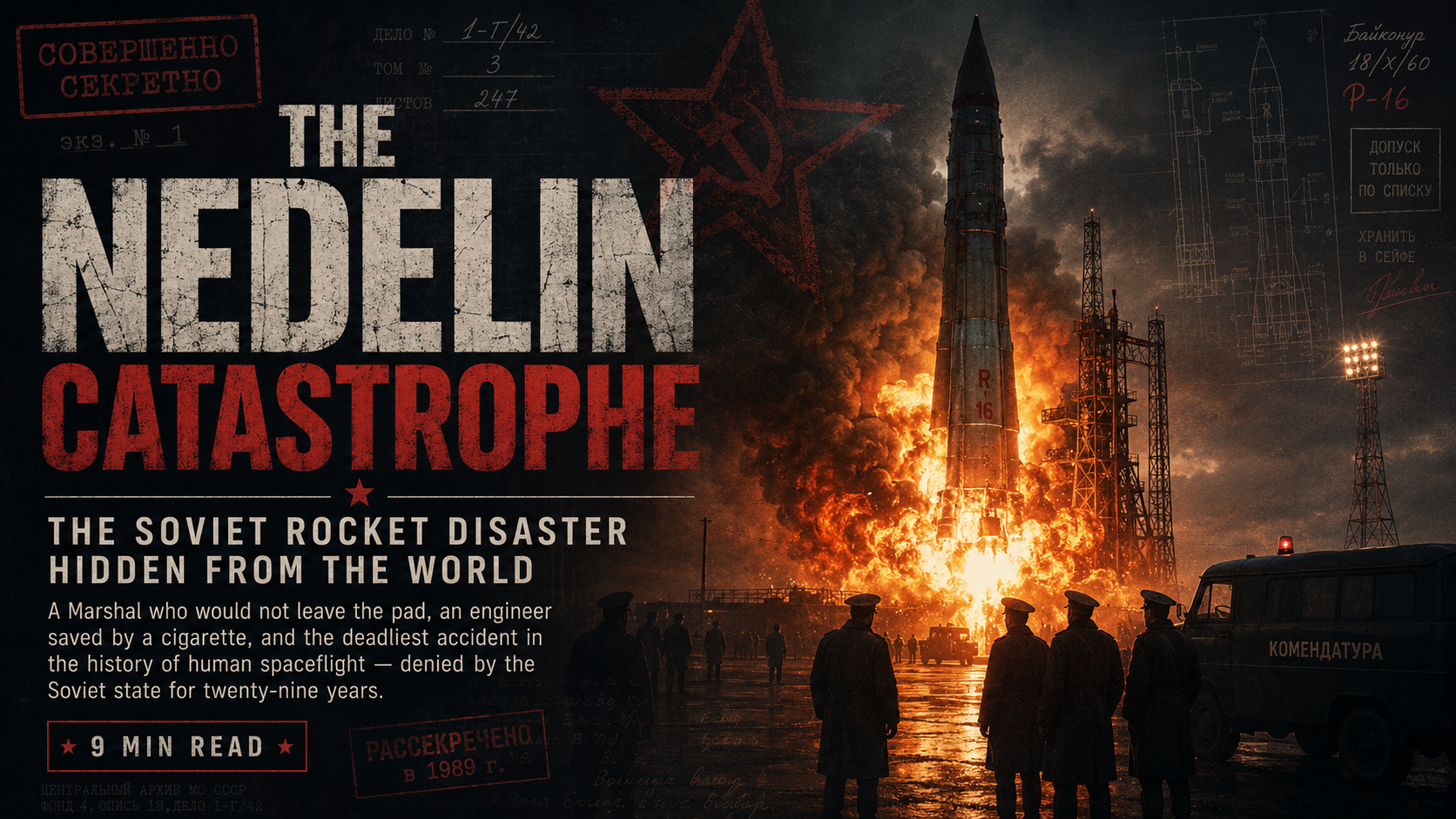
"He went out for a cigarette. That is the only reason he was alive." — Boris Chertok, deputy to Sergei Korolev, on the survival of rocket designer Mikhail Yangel, 24 October 1960.
There is a film, recovered decades after the event from a sealed Soviet archive, that shows the last thirty seconds of one hundred and twenty-six men's lives.
It is silent. It was shot from a remote bunker camera at the Baikonur Cosmodrome in the autumn of 1960, pointed at Launch Pad 41, where a tall, slim, R-16 intercontinental ballistic missile stood fully fuelled and ready for its first test flight. The image is grainy. The rocket dominates the frame. Around its base, indistinct figures move — engineers, soldiers, fuel technicians, observers — perhaps two hundred and fifty people in all.
For most of the footage, nothing happens.
Then, in a single frame, the rocket's second-stage engine ignites , while the first stage is still attached, still pressurised, still loaded with nearly two hundred tonnes of hypergolic propellant that catches fire on contact with air.
The fireball is the size of a small town. The figures around the pad are not figures anymore.
It would be twenty-nine years before the Soviet government admitted that this film existed, that the disaster had happened, or that Marshal Mitrofan Ivanovich Nedelin , Chief Marshal of Artillery and supreme commander of the Soviet Strategic Rocket Forces, had not, in fact, died in a tragic plane crash on a routine inspection tour.
A Disaster Set in Motion by a Calendar
To understand why so many people died on a launch pad in Kazakhstan that October afternoon, you have to understand what was happening on the other side of the world.
Date Context
April 1957 USSR's R-7 rocket (Korolev's) succeeds — but is impractical as a military weapon
1958 Soviet leadership demands a faster, storable-fuel ICBM
1959 Mikhail Yangel's design bureau begins work on the R-16
Late 1960 Khrushchev wants a successful launch before the November 7 anniversary of the October Revolution
24 October 1960 First R-16 test launch, brought forward under intense political pressure
The R-7 — the rocket that had launched Sputnik — was a magnificent space vehicle but a terrible weapon. It used liquid oxygen as oxidiser, which had to be loaded immediately before launch and could not be stored. In a nuclear exchange, this would have meant the United States destroyed the Soviet missiles long before they could be readied.
The R-16 was meant to solve this. It used nitric acid and unsymmetrical dimethylhydrazine (UDMH) — a hypergolic propellant combination, meaning the two ignite the instant they touch. The fuel could be stored in the rocket for long periods. It could be launched in minutes.
It was also one of the most lethal chemical cocktails ever assembled by human engineering.
Nitric acid burns through skin. UDMH is a savage carcinogen and a nerve poison. Their vapour, alone, can kill. Together, they ignite. The R-16 was, at full fuel load, essentially a 30-metre bomb of slow-burning toxic flame, balanced on a launch table in the Kazakh desert.
The Marshal Who Would Not Leave
The man in charge that day was Mitrofan Nedelin — sixty-eight years old, decorated hero of the Great Patriotic War, recently appointed to oversee the entire Soviet strategic missile programme.
Nedelin was not a rocket engineer. He was an artillery commander, accustomed to the discipline of cannons and battlefield deployments. He had been ordered, in the bluntest terms, to deliver the R-16 to operational status as quickly as possible.
On the morning of 24 October, the launch attempt was already in trouble.
Time Event
Morning Final fuelling of the R-16 begins
Several hours in Engineers detect leaks in the rocket's propellant system
Mid-afternoon Electrical anomalies in the launch sequencer are reported
18:00 local Nedelin orders work to continue with fuel still loaded — a serious violation of safety doctrine
18:45 The second-stage engine ignites unexpectedly
What happened in the hours before the explosion is the part that still chills survivors decades later. Standard procedure, when a fuelled rocket developed faults of this severity, was to drain the propellant , repair the systems, and re-fuel afterward. This would have taken days, perhaps weeks. It would have meant missing the November anniversary.
Nedelin refused. He ordered the engineers to fix the rocket as it stood , fully fuelled, on the live pad. To reinforce his point, he had a chair brought from his command post and sat down approximately twenty metres from the base of the missile.
Marshal Nedelin sat there for hours, smoking, watching the engineers work.
His presence had the effect he intended. With the commanding officer of the entire programme physically beside the rocket, no junior officer would dare suggest a withdrawal. Around him, in concentric circles of nervous activity, the technical teams swarmed the missile. By the time the second stage ignited, at least 250 personnel were within the lethal radius.
The Engineer Saved by a Cigarette
About fifteen minutes before the explosion, Mikhail Yangel — the chief designer of the R-16 himself, the man on whose shoulders the entire programme rested — stepped away from the pad to smoke a cigarette in a designated area roughly two hundred metres from the launcher.
This was a small act of nicotine addiction. It was also the single decision that preserved the future of the Soviet missile programme.
When the rocket ignited, Yangel was just outside the perimeter of total destruction. He survived. His deputy, his lead engineers, his propulsion team — most of them within the perimeter — did not.
Boris Chertok, the deputy to Korolev, later wrote that Yangel returned to a scene that defied comprehension. The pad was a sea of burning fuel. Men were running, on fire, into the surrounding scrub, only to collapse and die from the toxic vapour that drifted with the wind. The metal of the launch tower was running like wax.
Nedelin's chair was empty. Nedelin himself was identified, eventually, by the heat-warped Marshal's star pinned to a fragment of his uniform . There was nothing else left of him to recognise.
The Toll
The exact death toll has never been definitively established. Soviet records were sparse, deliberately altered, and in some cases destroyed. Modern estimates vary:
Source Estimated Deaths
Initial Soviet internal report (1960) 78
Official Soviet acknowledgement (1989) 92
Russian state records (post-1991) 126
Some independent historians Up to 150+
Among the dead were the deputy chief designer, the chief engineer of the launch complex, the commanders of two ground support battalions , and the bulk of the technical leadership of the R-16 programme. The Soviet Union lost, in less than a minute, an irreplaceable concentration of rocketry expertise that took years to rebuild.
Most of the victims did not die in the initial fireball. They died from the propellant vapour , which spread across the steppe for kilometres after the explosion. UDMH inhalation causes seizures, respiratory failure, and death within minutes at high concentrations. Many of those who initially fled the pad were found later, collapsed in the surrounding fields, untouched by flame but killed by what they had breathed.
The Cover Story
By dawn on 25 October, the Soviet propaganda apparatus was already at work.
TASS , the state news agency, issued a brief statement that Marshal Nedelin had died in a plane crash during an inspection tour. He was given a state funeral with full military honours. He was buried in the Kremlin Wall Necropolis, the highest honour the Soviet state could bestow. No mention was made of Baikonur, of the R-16, or of the hundred-plus other men who had died alongside him.
The families of the dead received notification that their husbands and sons had died in "accidents during the performance of military duties." They were instructed not to discuss the circumstances. In several documented cases, surviving wives were told that any disclosure would result in the loss of their pensions, their housing, or their children's educational prospects.
A complete information blackout was imposed across the Baikonur cosmodrome. Personnel were ordered to sign nondisclosure statements. The launch pad — Pad 41 — was rebuilt, the surrounding ground stripped and replaced.
Western intelligence agencies, monitoring the Soviet space programme from satellites and signals interception, suspected that something had gone catastrophically wrong. A CIA briefing in early 1961 noted unusual activity at Baikonur in late October, an abrupt halt in R-16 development, and the disappearance of several named Soviet engineers from public records. But suspicion is not proof. The Soviet state's word — that Nedelin had crashed in a plane — was the only official statement on file, and the Cold War etiquette of the era preferred not to escalate over unprovable accusations.
For twenty-nine years, the catastrophe officially did not exist.
The Truth, Slowly Unsealed
The first cracks appeared in the late 1980s, during Mikhail Gorbachev's policy of glasnost — the deliberate Soviet experiment in openness .
Year Disclosure
1989 Soviet press first acknowledges that Nedelin died in a rocket accident, not a plane crash
1990 Partial casualty figures published in Ogonyok magazine
1992 Post-Soviet Russian state releases declassified documents on the R-16 disaster
1995–2000 Survivor memoirs (notably Boris Chertok's four-volume Rockets and People ) reach wider Russian and English audiences
1999 Soviet bunker film footage of the explosion publicly released for the first time
By the late 1990s, the basic outline was known. The disaster had a name — Nedelinskaya katastrofa, the Nedelin Catastrophe — and a date that began to appear in Russian space-history textbooks. A memorial was eventually erected at Baikonur.
But the cover-up had done its work. Even today, the precise list of victims has never been published in full. The Soviet state classified the names of the dead alongside their bodies. Some families never learned, with certainty, what had happened to their husbands and fathers.
The Lesson Nobody Learned
The most haunting fact about the Nedelin Catastrophe is not the fire, or the secrecy, or the body count.
It is that the same political pressure that killed those men kept killing , in different forms, for the rest of the Cold War. The R-16 was rushed because Khrushchev wanted a parade. Soyuz 1 would be rushed in 1967, killing Vladimir Komarov, because Brezhnev wanted to mark the fiftieth anniversary of the Revolution. The Space Shuttle Challenger would be launched in 1986 with cold-degraded O-rings because NASA had been pressured to deliver a flight before the State of the Union address.
The technologies change. The institutions change. The men in the chair beside the rocket change. The mistake — we will hold the schedule even when the engineers say no — does not.
Marshal Nedelin sat in his chair because the calendar mattered more than the warnings. The men around him stayed because he stayed. The disaster did not happen because someone made a single bad decision. It happened because, for a long string of hours, no one in authority was willing to make a good one.
The rocket exploded. The state lied. The dead were buried in unmarked plots, and a Marshal's star was found in the ashes. And the world, for nearly three decades, was told a different story — a small story, about a plane crash, about a man who had simply been unlucky in the air.
Related Notes / Sources Consulted
Chertok, Boris. Rockets and People , Volume II: Creating a Rocket Industry (NASA History Series, English translation, 2006) — the most authoritative first-hand account by a senior Soviet space engineer who arrived at Baikonur immediately after the disaster.
Siddiqi, Asif A. Challenge to Apollo: The Soviet Union and the Space Race, 1945–1974 (NASA SP-2000-4408) — definitive scholarly treatment drawing on declassified archives.
Harford, James. Korolev: How One Man Masterminded the Soviet Drive to Beat America to the Moon (Wiley, 1997) — broader context on the rivalry between Korolev's and Yangel's design bureaus.
Ogonyok magazine , 1990 — first major Soviet press disclosure of the catastrophe.
Russian State Archive (RGANTD) — declassified R-16 programme files, released in stages 1992–2001.
Baikonur Cosmodrome Memorial — official Russian state monument and casualty record (incomplete).
CIA declassified intelligence reports , October–December 1960 — Western suspicions of an unannounced Soviet launch-site disaster.
Editorial note: The Nedelin Catastrophe is now established historical fact, documented in Russian state archives, survivor memoirs, and declassified Western intelligence. This article describes confirmed events. Casualty figures vary across sources and are presented as a range, in line with the historical record. The cover-up itself — the plane crash fabrication — is also documented in primary Soviet press materials from October 1960.